Article
New Amazon Brand Registry Tool for Product Page Content Control
Amazon recently gave brands a lever they never had before: the ability to decide, by account, whose data wins when two or more selling partners submit different values for the same product attribute.
For years, the answer to “who controls my Amazon listing content?” has been a gray area. Using Brand Registry as an approved brand representative gives your contributions more weight in Amazon’s eyes, but it has never let brands directly set this hierarchy themselves. If a distributor submits an incomplete attribute or a reseller edits a product title, the brand usually only finds out when they notice the live Amazon detail page looks different.
Amazon’s new Rank Catalog Contributors tool is changing this. If it’s as promising as it sounds, this can be a major help for brands enrolled in Amazon Brand Registry who face lots of resellers on their product detail pages. That said, our look into this new tool also comes with some important caveats worth highlighting.
How the New “Rank Catalog Contributors” Tool Works on Amazon
A catalog contribution is an Amazon selling partner’s request to update a product’s detail page content. According to Amazon’s Brand Registry documentation, any selling partner offering the same product can act as a contributor and submit changes. For brand-registered products, Amazon considers attribute values from partners with brand selling roles, and when multiple Brand Representatives or Resellers submit different values for the same attribute, Amazon uses the brand’s contributor ranking to decide who takes priority.
That ranking is what the tool controls. Brand Administrators assign ranking numbers to account IDs, and Amazon evaluates contributors in that order, starting at #1. Amazon’s documentation is specific that only partners who have actually contributed to a given attribute are considered in the evaluation, which means the ranking settles conflicts.
Two important details about how this is rolling out:
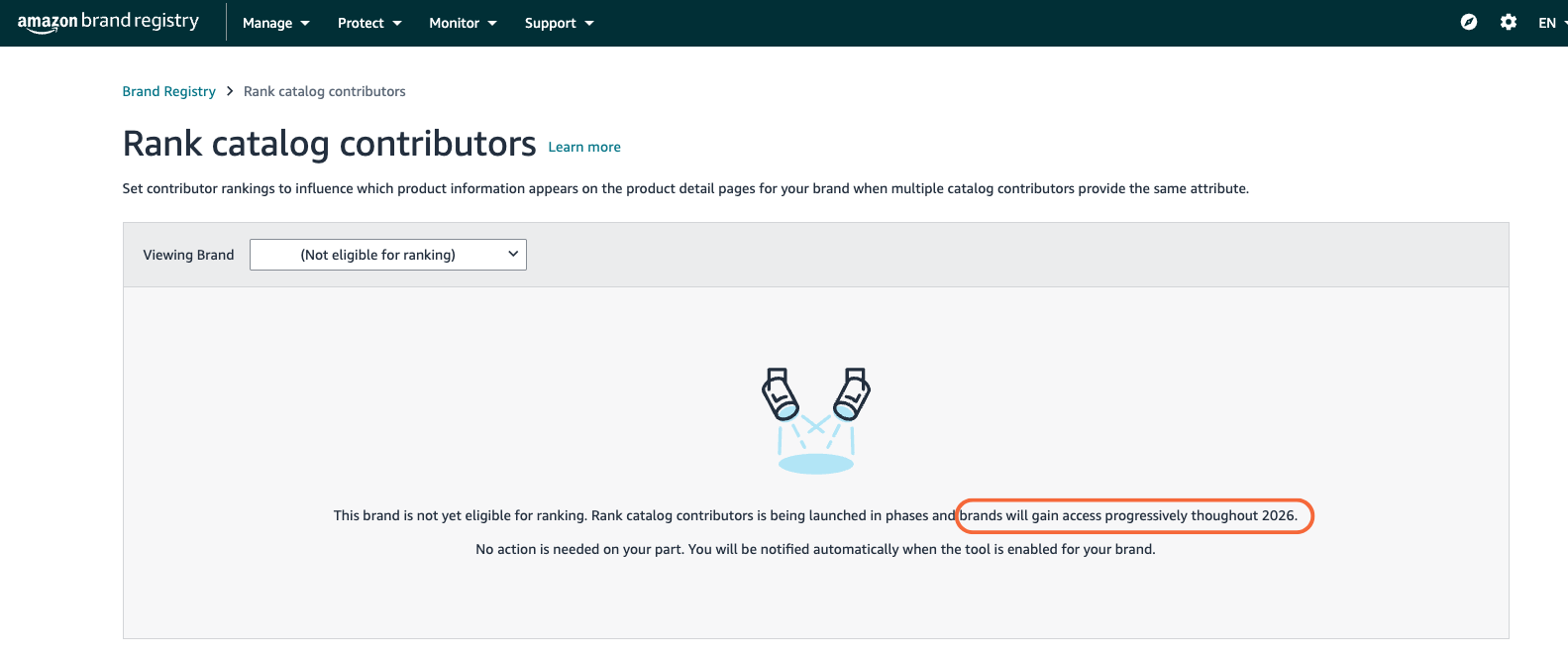
- Not everyone has access yet. Amazon is rolling the tool out progressively over the next few months. If you are an Administrator and either cannot see it or see “Not eligible for ranking,” that is expected. Amazon’s direct guidance is that brands should not open a support case to request access, and eligibility cannot be expedited.
- Amazon already built you a ranking. Once you gain access, Brand Registry automatically generates a ranking for every selling partner connected to your brand, based on Amazon’s own logic. No action was required on your part, and you were not asked to approve it. If you have the tool, there is an active ranking on your brand right now that you did not set. Review what is there already and make changes if needed.
Why Contributor Ranking Matters for Brand-Registered Sellers
Contributor order directly influences which titles, bullets, descriptions, variation data, and other product information appear on an Amazon product detail page. If you have ever seen approved content get overwritten or found a backend attribute populated with a value nobody on your team submitted, this is a new mechanism to control it.
Catalog Data Consistency Directly Ties to AI-Powered Discovery
We’ve seen more and more the past couple of years that incomplete and conflicting product data is exactly what weakens listing performance in Amazon’s AI-powered discovery funnel. This is because a product Amazon cannot interpret confidently is a product it is less likely to surface. Contributor ranking is the first native control that lets a brand enforce a single version of its product story at the source.
More Reseller Management Control on the Open Amazon Marketplace
This update also finally lets brands answer, “who, specifically, is authorized to speak on our products?”
In Brand Registry, Amazon defines a Brand Representative as an internal, first-party selling partner directly employed by the brand and a Reseller as an external, third-party partner the brand has authorized to sell on Amazon.
What You See Inside the Catalog Contributors Tool
Go to Brand Registry → Manage → Rank catalog contributors. Select a brand from the Viewing Brand dropdown. You will see the current contributors ranking: a numbered list of contributors, each with the account name displayed in Seller or Vendor Central, the account ID, and the assigned selling role. Rank #1 is the highest priority.
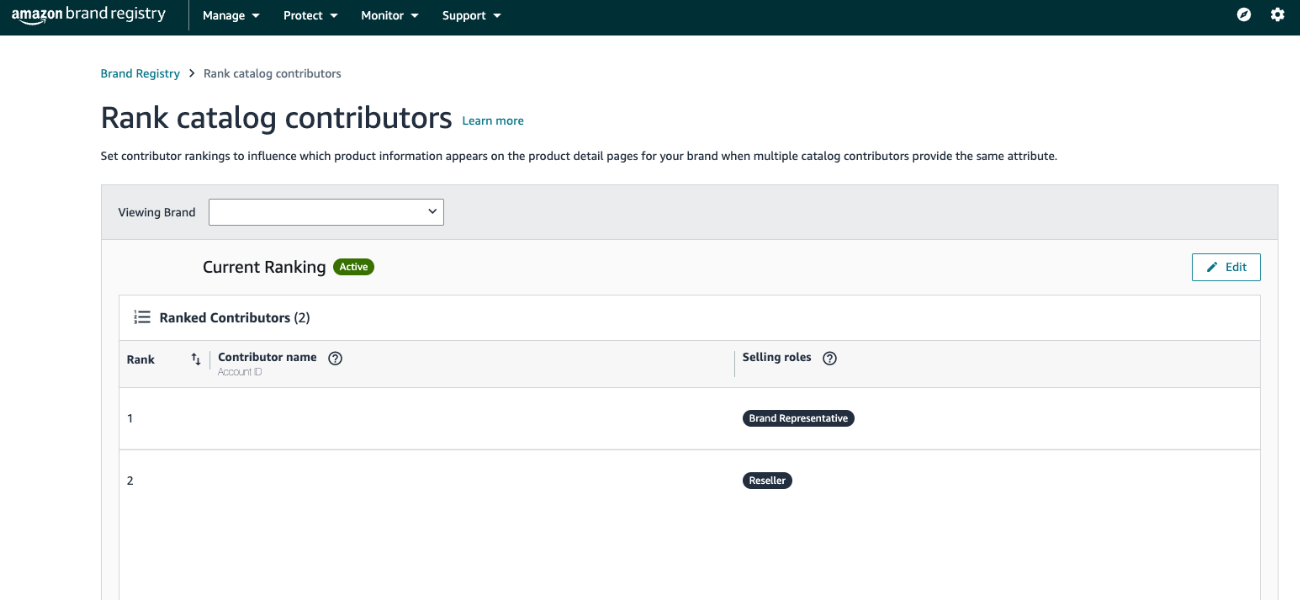
Click Edit and the ranking becomes editable. You can type a new rank number or drag a contributor into position.
A few capabilities worth knowing about:
- Unranked contributors: Click “Show unranked contributors” to see partners with a selling role who are not in the ranking, then add them. New additions land at the bottom, so you may need to reorder your list after adding them.
- If a partner does not appear anywhere in the ranking options, it is because they have not been assigned a selling role at all. That needs to be handled under “Manage selling roles.”
- Save a draft: You can preserve edits before publishing them, which may be helpful to review with your team internally before pushing them live. You can return later to resume editing or throw the draft away.
- Copy from other brands: If you hold Administrator roles across multiple brands that share contributors, you can import an entire ranking configuration from one brand into another. For a portfolio with the same distributors across several brands, this means you only have to decide on contributor rank once.
Pushing Your Catalog Contributor Rankings Live
When you have finished reordering your contributors ranking and are ready to push the changes live, click Submit. Amazon then asks you to choose between “Generate impact report” and “Publish immediately”. The change will only take effect once you confirm via the “Publish” option.
Changes can begin appearing on your Amazon product detail pages shortly after publication or up to 10 days for all past contributions to be reprocessed.
Ranking Catalog Contributors Won’t Solve Every Problem
This is one of the more meaningful catalog controls Amazon has shipped in a while. It addresses a real and long-standing problem, and it does so at the right layer: the attribute level, where conflicts actually happen.
Despite this being a helpful tool for brand representatives, the tool functions in a narrower capacity than its name suggests.
Removing a Catalog Contributor Does Not Guarantee Complete Blockage
Contributor ranking is not enforcement. This is the single most important thing to understand. Per Amazon’s documentation, removing a contributor from the ranking does not block them from selling an ASIN or contributing to a product detail page. Removing a contributor only means Amazon will implement their contributions at the lowest possible value. The contributor is still there, still submitting, and still winning any attribute where nobody above them has contributed a value.

Blank Product Attribute Fields Can Override Rankings
Attribute completeness beats ranking priority. Ranking only decides who wins a contested attribute.
On any attribute where your own account submitted nothing, there is no contest; whoever submitted wins by default — regardless of rank. In our experience, that opening is also a vulnerability. Bad actors sometimes fill blank attributes with flagged words or values, and the brand does not always catch those contributions. If an ASIN is taken down and needs reinstatement, request to see contributions on fields you never populated; something submitted by a bad actor may need to be cleared first.
Contributor ranking raises the ceiling on catalog control, but complete attribute data is still the floor.
The Gap That Exists Today: The Impact Report
Before you fully submit a ranking change, Amazon offers sellers the option to save the change as a draft and preview how those changes may impact the catalog by downloading an Impact Report. Amazon’s documentation recommends generating the report before publishing any ranking changes as these rankings affect your catalog and can lead to unintended changes (including broken variations and product listing inconsistencies) if not updated correctly.
A ranking change leads to re-evaluation of every attribute where your ranked contributors disagree. This is done across your entire catalog and can take up to 10 days for all past contributions to be reprocessed. The impact report lets you see what the change would do before you commit to publishing it.
The report can take up to 24 hours to generate, notifies the Administrator when ready, and arrives in two tabs:
- A summary of how many ASINs would be affected were that ranking to be pushed through
- An ASIN-level preview showing current values against proposed new values, alongside the ranked contributors and their account IDs
A Real Limitation: Reporting Not Available
In practice, we have not been able to get this report to appear. We have escalated it to Amazon’s internal team and are waiting on a resolution.
Right now, the only way to see what a ranking change does to your catalog is to publish it and watch. That is a much bigger risk, as of today, compared to what Amazon’s documentation currently describes. Until the reporting is up and running, brands should be more cautious with making ranking changes.
Until the report works, you can run a test by making a small change and monitoring it closely before making a second, more drastic change.
Because of this current limitation, we do not recommend restructuring your contributor list in one pass.
Steps Brands Can Take Right Now
We built a standard process for this new capability when we saw the tool begin to roll out in early September. Our approach is deliberately conservative because of the power the tool possesses to rewrite live product data (plus, the preview mechanism is not currently dependable).
- Capture your starting point before making changes. Record the date and document every contributor’s current rank, account name, account ID, and selling role. If a ranking change goes wrong, this is the only record of what the catalog looked like beforehand.
- Review Amazon’s default ranking. Amazon generated an initial order for every brand using its internal logic. We have not seen it produce an obviously wrong result, but it was not built with knowledge of which partners are authorized to speak on behalf of your brand. Treat it as a starting point, and consider revising it if needed.
- Validate every contributor. Every seller gets matched to a known brand account, Vendor Central account, Seller Central account, reseller, distributor, or authorized agency. Anything that does not match (an unfamiliar account, inaccurate role, partner who has gone inactive, account tied to past content conflicts, etc.) should get flagged before any reordering is considered. Two important things to look for are whether each selling role is accurate and whether any contributor relationship is no longer authorized.
- Decide on re-ranking as needed. Your brand team should review the existing ranked list and determine whether re-ranking is needed. Consider who your brand has previously confirmed should control content and what your preferred order is from there. We recommend your Brand Representative maintain the #1 ranking.
- Be aware of re-ranking impact on existing content. Moving a contributor’s ranking down will deprioritize their existing submissions. If deprioritizing a reseller also means deprioritizing their submitted bullet points or product description, you should submit that content from your own account. This is also why we recommend leaving reordered rankings as a draft until you’ve assessed its impact on your detail pages.
At this point, your team should determine whether keeping the rankings in Draft, pushing one small change live, or pushing the entire list live is the best choice. The answer may differ depending on how many contributors you have (eg: if there is only one other contributor aside from your Brand Representative, you may be safe to push rankings live as long as they are #2).
Monitor Your Catalog After Rankings Are Published
We recommend using a recurring schedule to monitor your catalog for potential changes after publishing your contributor rankings.
- Within one business day, confirm the ranking is active and spot-check priority ASINs.
- At days 3-5, re-check affected high-priority ASINs and their variation relationships.
- At day 10, when Amazon’s reprocessing window closes, run a final sample.
Contributor ranking is not necessarily a one-time configuration. Partner relationships change, distributors come and go, and a ranking set correctly in October may be wrong by spring if nobody revisits it. We are treating it as a quarterly review with trigger-based exceptions, the same way we treat catalog audits.
New selling partners, changed relationships, or approved content that repeatedly fails to display are all reasons to review the ranking before the quarter is up.
Watch Variation Structure Closely
Variation structure is the hardest thing to watch but can be the most damaging. An unexpected parent/child movement, split, or merge can affect your PDP visibility and shopping experience much more than a rewritten bullet point.
What to Expect Next
The key question is whether this contributor ranking makes a big difference for brands. In theory, it should mean approved content holds, fewer overwrites need to be chased down, and less time is spent reversing changes nobody on your team authorized in the first place. This is what the tool promises.
Since this was recently announced and is still rolling out, we do not yet have enough data to confirm how helpful it is, especially because the impact report (that would let us measure the before-and-after precisely) is not yet available.
Conclusion
Right now, if you have access, review what your rankings currently show and make sure that there isn’t anything majorly wrong with the accounts that have access or their ranking order.
Establish a baseline, then measure what actually changed over the next quarter (overwrite frequency, content stability, time spent on catalog resolution, etc.)
As always, our catalog team is keeping a close eye on advancements that impact our brands, and is coordinating with Amazon on resolution to the reporting gap. We’re happy to help your team with role access, prioritization of contributors, testing changes, or just answering questions. Reach out to us through the link below to start a conversation.