Article
Recap of Amazon’s Q4 2025 Earnings for Marketplace Sellers
Amazon’s Q4 earnings report has been released, and we’re breaking down the complex data into a few top takeaways for sellers on its marketplace.
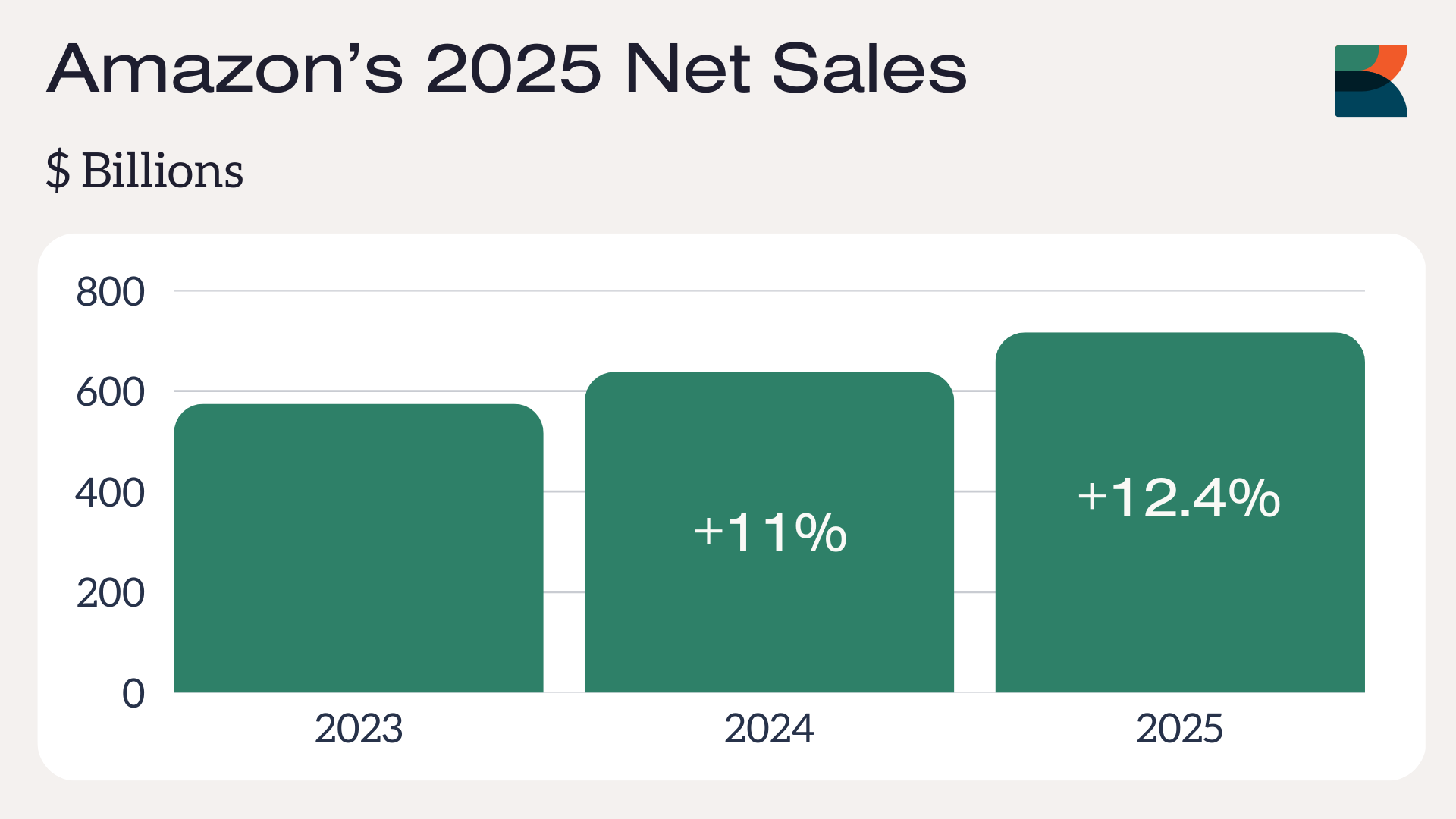
Amazon hit a record $716.9 billion in annual revenue for 2025, potentially outpacing Walmart for the first time in history. While the top-line growth is impressive (Q4 Net Sales up 14% to $213.4 billion), the story for brands selling on the marketplace is more complex.
Our CEO’s breakdown of Amazon’s earnings Q4 2025 report uncovered that the company’s growth has been increasingly driven by increased operational efficiency, advertising revenue, and seller fees rather than organic ecommerce product volume. For brands, this signals a long-term marketplace environment where margin preservation is the primary challenge. Many brands faced this challenge in 2025, and unfortunately it will remain a priority in 2026 and beyond.
Amazon’s Q4 2025 Earnings Breakdown: What Drove the Most Revenue?
1. Record Financials
Amazon’s earnings report noted that the company’s Q4 2025 net sales reached $213.4 billion (+14% YoY).
Full-year 2025 sales hit $716.9 billion, up 12.36% from 2024. Last year also outpaced 2024’s YoY growth as net sales only rose 11% from 2023-2024.
Operating income also rose, reaching $25 billion in Q4 (up from $21.2 billion in Q4 2024), further demonstrating Amazon’s focus on operational efficiency.
2. Segment Performance
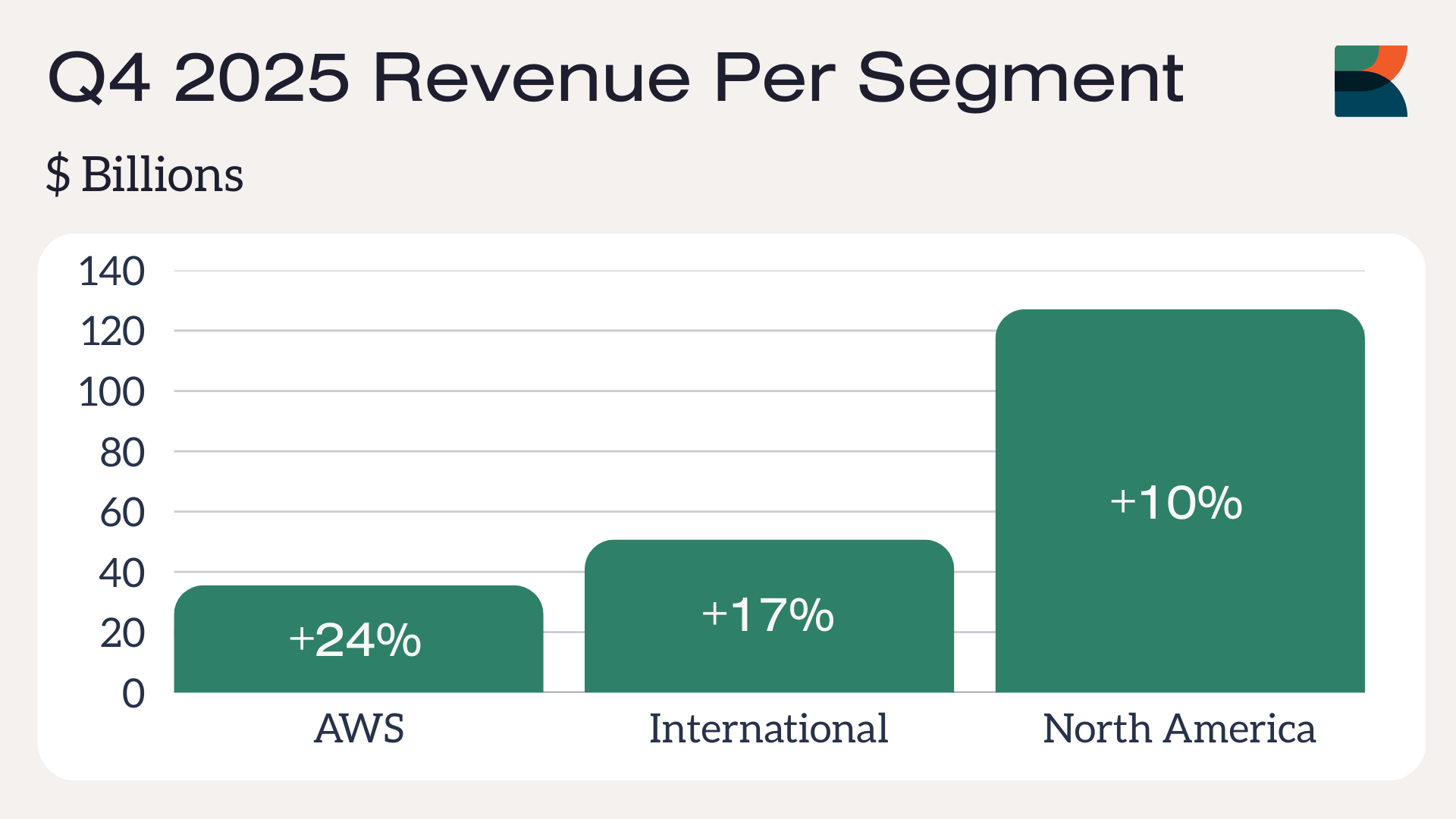
- North America: Amazon’s Q4 2025 North American sales increased 10% YoY to $127.1 billion. This segment continues to dominate as Amazon’s primary revenue driver.
- Amazon has long-invested in this channel, but we are seeing more dramatic increases across International and AWS, with greater year-over-year growth in these other areas. If this trend continues, what will the outlook mean for brands? We break it down in the next section of this article.
- International: Amazon’s earnings report highlighted a strong International performance in Q4 2025 with 17% YoY growth totaling $50.7 billion in revenue.
- This comes after we’ve seen Amazon lean more into international markets the past few years, with many brands now selling in (or considering selling in) European marketplaces like Belgium, Germany, Spain, Sweden, and Poland, among others.
- AWS: Profit from Amazon Web Services continues to grow, up 24% YoY totaling $35.6 billion in Q4 earnings alone.
- Although AWS is the smallest revenue-driver compared to International and North American segments, it is also the fastest-growing. There is massive demand for high-intensity computing tasks that companies are paying AWS to handle, with a prime example cited in Amazon’s Q4 earnings report of Anthropic training its industry-leading AI model, Claude, with AWS.
Q4 Earnings Report Impact on Sellers: Is Amazon’s Gain Your Loss?
1. Advertising Revenue Growth = Margin Compression
Amazon’s advertising services revenue jumped ~22-23% YoY to $21.3 billion in Q4 2025, consistent with strong demand and expanding formats (including Prime Video ads).
While Amazon celebrates this Q4 growth, it is a negative indicator for sellers:
- Underscores the importance of advertising investment
- Competing on the platform is becoming significantly more expensive
- As ad costs rise, brands will see continued crunching of margins
2. Retail Growth: Demand vs Tariffs & Inflation
Amazon’s retail presence (online + physical) was solid, but not exceptional in Q4. North America retail sales grew 10% and International grew 17% (or ~11 % excluding foreign exchange impacts), showing moderate ecommerce and physical store expansion.
While these numbers look solid, they lack nuance. It remains unclear if this growth is driven by actual increased consumer demand (unit volume) or simply higher prices YoY (as a result of inflation & tariffs), especially in durables.
3. Third-Party Seller Services & Fees
Third-party seller services (which include marketplace and related reselling revenue) grew respectably, up ~11% in Q4 2025, a sign of continued strength in Amazon’s platform for independent sellers.
With more business moving here, so are fees, which bolster this number. To break it down, if revenue was up 11%, we know a chunk of that was from increased fees, and another chunk was driven by higher retail prices due to tariffs. This is another negative for brands as the platform not only becomes increasingly competitive, but Amazon leans more into this revenue stream (acting as another tax on brand profitability).
4. Competitive Q4 Landscape for Amazon Retail & Sellers
Reports noted Amazon, locked in a fierce battle for market share with Walmart (which is growing its own ecommerce and ad business aggressively), is under pressure to maintain retail margins. By engaging in aggressive price matching against Walmart, Amazon’s margins on the 1P side are compressing. When Amazon 1P cannot profitably match a street price (for example, if Walmart drops a price significantly), the algorithm may switch channels.
To maintain dominance, Amazon is hunting for the most profitable channel to sell inventory. We are seeing this manifest as a much less consistent buy box, creating volatility for brands as Amazon aggressively adjusts pricing and logistics to compete.
Amazon’s algorithm is calculating—transaction by transaction—whether it makes more net profit selling the item itself (1P) or collecting fees from a third-party seller (3P). Collecting a fixed ~15% referral fee from a third-party seller is often more profitable for Amazon than selling the unit itself at a near-zero margin.
- 1P (Retail): Amazon buys, owns, and sells the inventory.
- 3P (Marketplace): A third-party seller owns the stock, and Amazon collects referral and FBA fees.
Example: If Amazon 1P cannot match a competitor’s price (eg: Walmart) profitably, it may suppress its own listing and hand the buy box to a 3P seller to protect its bottom line. This results in the erratic buy box behavior (suppression and rotation) brands are currently experiencing.
With these retail margin pressures and competitive pressures, especially vs Walmart, Amazon has leaned even further into aggressive pricing and logistics investment. This is another example of Amazon prioritizing its own profit in Q4 even though doing so results in instability for sellers on its marketplace.
What Amazon’s Q4 Earnings Imply About Sellers in 2026
Here is some forward-looking advice based on Amazon’s stated goals for the coming year.
1. AI Features Will Continue to Increase
Amazon plans to spend nearly $200 billion on capital expenditures in 2026, primarily on AWS and generative AI.
For brands: The focus on AI search & Rufus will only continue to grow. Expect AI to permeate every part of Seller Central, from the “Rufus” shopping assistant to AI-generated ad campaigns.
Don’t worry too much about making changes to your listings to “optimize for AI” though—we recently wrote an article on how slow consumer AI adoption will actually take and how important a strong brand foundation is for staying visible.
2. Product Delivery Speed is a Differentiator
Amazon delivered at its fastest speeds ever during 2025, with Same-Day delivery volumes up 70%.
For Brands: Logistics remains a key area of importance. Many brands are already utilizing FBA, or at least highly efficient 3P logistics, to meet the delivery speed expectations set by Amazon. Expect that Prime-eligible products will remain a priority on the marketplace, especially when it comes to earning the buy box.
Conclusion: Amazon Partners for the Long-Haul
2025 was a record-breaking year for Amazon’s topline revenue. 2026 and beyond will continue to require a focus on efficiency for brands selling on the marketplace.
With rising ad costs and volatile buy box behavior, “set it and forget it” strategies will continue to become increasingly outdated. Brands need to stay agile to protect their margins and succeed in growing on the marketplace.
At Brandwoven, we partner closely with brands selling on Amazon and other online marketplaces. We have seen first-hand how these marketplace pressures impact brand profitability.
For over 9 years, we have helped 125+ brands navigate this ever-changing landscape by implementing advanced strategies that tie into every area of your business:
- Logistics & forecasting, ensuring availability and speed
- Proper catalog set-up & ad management for discoverability
- Digital merchandising to optimize listings for conversion
If your brand is looking for advanced and agile strategies to succeed in this ever-changing marketplace landscape, set up a strategy call with our team.