Picture two nearly identical products side by side on the Amazon search results page. They are both within the same price range, have similar reviews, and are technically relevant to the user’s query. Yet, one consistently ranks higher, appears in Rufus-driven recommendations, and converts at a meaningfully better rate.
The difference between these two products is rarely ad budget or the number of reviews. In most cases, it is how completely and coherently each brand has built its catalog architecture, which directly impacts how confidently Amazon’s AI algorithm can interpret what each product is, who it is for, and where it belongs on the marketplace.
This article analyzes three Amazon product listings from the same category to demonstrate a few examples of exactly what happens when brands get this right, and what it costs when they don’t. We also provide a complete worked example showing how catalog authority translates into genuinely helpful Amazon product detail page copy across every content surface.
The Impact of Catalog Authority on Amazon’s AI Product Ranking Algorithms
In our last article, we explained how COSMO and Rufus have changed the game from keyword matching to semantic understanding. If you haven’t read that already, take a look to first see why Rufus makes specific product recommendations and how this ties into your catalog set-up.
In this article, we’ll demonstrate the visual and practical proof of how optimizing your product content to improve Amazon search rankings works in the real world.
In the following section, we’ll show what happens in a real Amazon category when two brands approach catalog set-up differently: one relying on brand momentum to compensate for product detail page gaps, and the other earning Rufus placement on catalog architecture alone.
3 Amazon Listing Examples with Varying Levels of Catalog Authority
To understand what catalog authority looks like in practice, and what it costs when it’s missing, it helps to look at examples of real Amazon listings within the same product category.
The following analysis examines three insulated water bottles competing for the same shoppers on Amazon: two real brands at different levels of catalog authority, and a third that illustrates what fully leveraged catalog architecture looks like across every content layer.
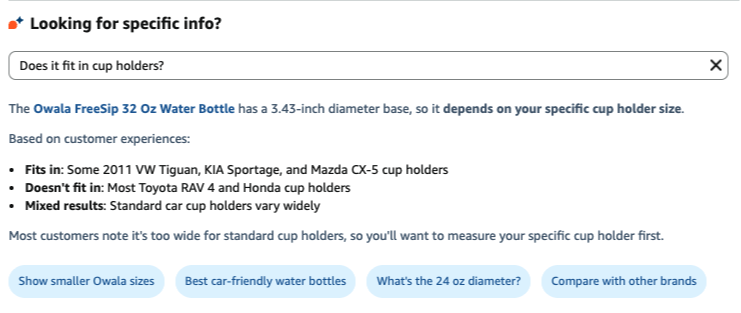
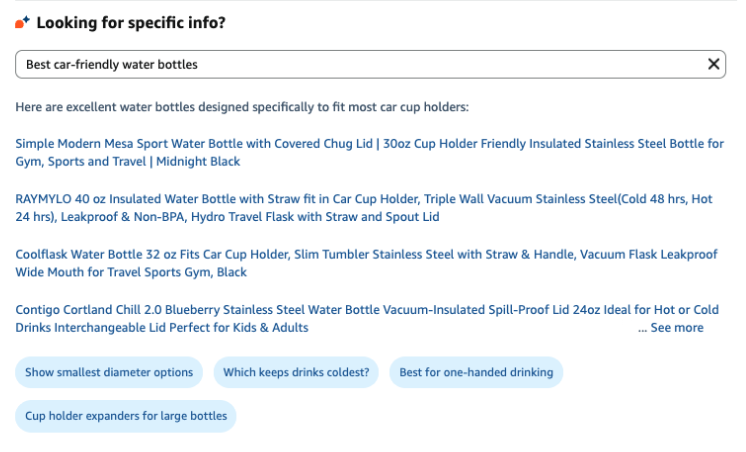
The evidence in this article comes directly from real interactions with Amazon Rufus. When a shopper asks “Does it fit in cup holders?” on a product detail page, then follows up with “Best car-friendly water bottles,” Amazon’s AI algorithm surfaces a clear ranking of which brands it trusts to answer that question and which ones it flags as a risk.
Example 1: Owala FreeSip – Strong Brand with Amazon Listing Gaps, Ranks on Momentum
The Owala FreeSip 32oz consistently ranks in the top five results for “32oz insulated water bottle” on Amazon. It is genuinely an excellent product with a loyal following. However, it’s product detail page is also a useful example of how far brand momentum can carry a seller that chooses to leave meaningful Amazon catalog authority on the table.
Product Title Analysis
Owala’s product title as it appears on Amazon:
- Owala FreeSip Insulated Stainless Steel Water Bottle with Straw, BPA-Free Sports Water Bottle, Great for Travel, 32 Oz, Denim
In terms of catalog authority, this title has significant gaps:
- “Great for Travel” is an adjective, not a verifiable claim
- There is no temperature duration or leak-proof assertion
- Critically, there is no cup holder compatibility callout despite fit being one of the most searched for factors at the decision-making phase within this product category.
The lack of compatibility/fit information has a clear consequence: when a shopper asks Rufus “Does it fit in cup holders?” directly on the product detail page, Amazon Rufus responds by flagging it as a problem. Rufus notes that the product’s 3.43-inch diameter base “doesn’t fit” most Toyota RAV4 and Honda cup holders, and “most customers note it’s too wide for standard cup holders.” Rufus then suggests the shopper look at “Best car-friendly water bottles” instead — actively directing them away from Owala toward competitors who have answered the compatibility question that Owala’s product detail page never even addressed. In this case, Owala is likely intentionally omitting that information because it is, in fact, not a great fit for car cup holders, but we will continue to use it as an example.
Listing Bullet Points
The bullet points on the Owala listing follow a similar pattern.
The FreeSip spout is genuinely unique and the brand leads with it correctly, but the bullets are overall feature-first rather than benefit-first, and there is almost no use-case language. This leaves Amazon Rufus’s product ranking algorithm with limited contextual information to work with beyond the words “sports” and “travel.”
Why Owala Still Ranks on Amazon
The #owala hashtag has been viewed over 272 million times on TikTok. Limited edition colorways have resold for hundreds of dollars. Years of review mass, external validation, and brand equity give Amazon’s AI an extremely confident amount of knowledge about the brand’s products regardless of listing completeness. Owala can afford incomplete catalog architecture. Most brands cannot.
Example 2: Raymylo – No Brand Momentum, Earns Placement Through Catalog Authority
The Raymylo 40oz Insulated Water Bottle is not a household name. It does not have a TikTok moment.
What it does have is deliberate catalog architecture, which is enough to earn it a placement in Rufus’s “Best car-friendly water bottles” results while Owala gets redirected away.
Product Title Analysis
The Raymylo title as it appears on Amazon:
- RAYMYLO 40 oz Insulated Water Bottle with Straw fit in Car Cup Holder, Triple Wall Vacuum Stainless Steel (Cold 48hrs, Hot 24hrs), Leakproof & Non-BPA, Hydro Travel Flask with Straw and Spout Lid
This title does almost everything an authoritative listing calls for:
- Cup holder compatibility is stated explicitly and early.
- Temperature duration is specific (48 hours cold, 24 hours hot: claims it can make because of triple-wall insulation).
- Leak-proof and BPA-free are present.
Listing Images
The listing images go beyond decoration to reinforce every claim the corresponding text makes:
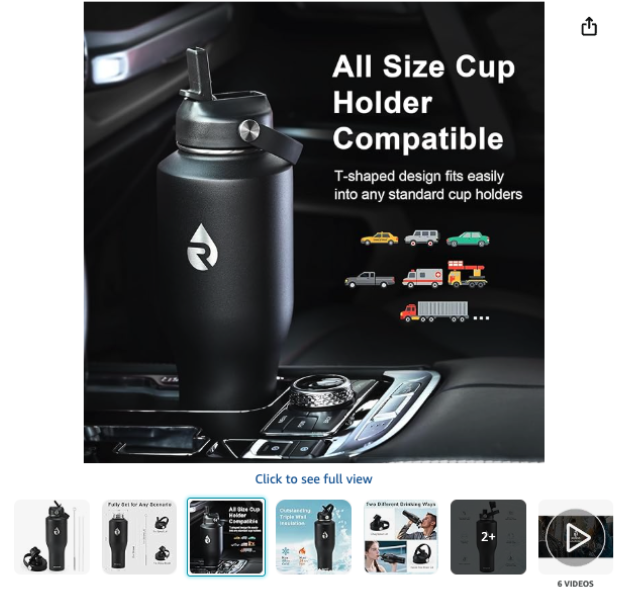
- A dedicated “All Size Cup Holder Compatible” image shows the bottle sitting in a real car console, with vehicle type icons confirming compatibility.
- A temperature infographic specifies the exact hours with a clean visual hierarchy.
- A features callout image covers 18/8 stainless, BPA-free, wide mouth, leakproof, and powder coat in a single organized frame.
- A size comparison image shows the 20oz, 32oz, and 40oz variants side by side.
Backend Attributes
The listing’s backend attributes appear well populated. The product surfaces when Rufus filters for car-friendly bottles, which means the compatibility data Amazon’s search ranking algorithm needs to make that match exists in the structured attribute layer, not just in the title.
One Brand Inconsistency: Product Videos
The brand’s listing only has one documented inconsistency.
Raymylo’s product video is titled “Insulated Tumblers with Handle & Straw Lid & Paracord Handle” but the listing is for a water bottle. The video calls it a tumbler (likely to capture impressions from folks who are searching for a tumbler in a fashion that is less visible to the consumer).
Amazon’s AI cannot read video content directly, but it can read the video title, and that title is now introducing a conflicting product category message into an otherwise coherent catalog.
A shopper asking Rufus “Is this a water bottle or a tumbler?” would receive an ambiguous answer.
A simple title correction, “Raymylo 40oz Insulated Water Bottle: Cup Holder Compatible, Triple Wall, Leak-Proof Demonstration”, would eliminate the fragmentation entirely. The video title is a single fixable error in an otherwise strong catalog architecture.
Now imagine this fragmentation compounding in the wrong direction. The brand’s video title error is a small example of how a single product page inconsistency can introduce noise into an otherwise coherent Amazon catalog. Multiply that across a full SKU range and the effect is no longer small.
Example 3: Catalog Authority in Practice, A Full Worked Amazon Product Page Example
The following is a complete content layer breakdown for the HydroVault 32oz Insulated Water Bottle by Vault & Co. (a fictional brand) used to illustrate what fully realized catalog authority looks like across every content surface. Think of it as Raymylo with no gaps: every layer deliberate, every field populated, every message consistent.
This section is designed as a reference for teams executing catalog work with each layer showing what deliberate content looks like and why it earns AI placement.
Product Positioning Example
- Keeps drinks cold 24 hours, hot 12 hours
- Leak-proof twist-lock lid
- Fits standard car cup holders (2.95-inch diameter)
- BPA-free 18/8 stainless steel
- Available in 24oz, 32oz, and 40oz
As we go through each content layer below, notice how the same pillars (temperature retention, leak-proof reliability, cup holder fit, and all-day versatility) appear consistently. This repetition across surfaces is what catalog authority looks like in practice.
1) Product Title
- Vault & Co. HydroVault 32oz Insulated Water Bottle, Keeps Drinks Cold 24 Hrs, Hot 12 Hrs, Leak-Proof Lid, Fits Car Cup Holder, BPA-Free Stainless Steel
Why it works:
- Brand name leads (Brand Registry requirement).
- Every claim is specific and verifiable (eg: “24 Hrs” not “all day”)
- Cup holder compatibility is a high-intent filter most competitors omit entirely.
Compare this to Owala’s “Great for Travel”; same character count, but four times the specificity.
2) Listing Bullet Points
- Stays Cold Up to 24 Hours, Hot Up to 12 Hours: Double-wall vacuum insulation keeps ice water cold through a full workday and hot coffee warm through your morning commute. No condensation on the outside, no lukewarm surprises halfway through your hike.
- Secure Twist-Lock Lid for Leak Resistance: The HydroVault twist-lock lid is designed to create a tight seal to help prevent spills in gym bags, backpacks, or car cup holders. Built for everyday carry whether you’re commuting, traveling, or heading to the gym.
- Designed to Fit Most Standard Cup Holders: With a 2.95-inch base diameter, the HydroVault bottle fits most standard car cup holders, treadmill holders, truck consoles, and stroller cup holders for easy transport.
- Durable Stainless Steel Construction: Made with 18/8 food-grade stainless steel for durability and clean taste. Dishwasher-safe lid for easy cleaning; bottle recommended for hand washing.
- 32 oz Capacity for Daily Hydration: Large 32 oz capacity helps keep you hydrated throughout the day. Wide-mouth opening accommodates ice cubes and standard bottle brushes. Also available in 24 oz and 40 oz sizes.
Why it works:
- Each bullet leads with a benefit, not a feature.
- Specifics replace adjectives (“2.95 inches” not “slim profile”).
- The final bullet handles size comparison, useful for Rufus answering “which size should I get?”
Objections are pre-empted before shoppers can raise them.
3) Product Description
- Most insulated bottles force a trade-off between performance and convenience. Some keep drinks cold but don’t fit in a cup holder. Others fit easily but spill in your bag. The HydroVault is designed to balance temperature performance with everyday portability.
- Double-wall vacuum insulation helps maintain drink temperature for up to 24 hours cold and 12 hours hot. The twist-lock lid is designed to create a secure seal for travel in gym bags, backpacks, or car cup holders. With a 2.95-inch base diameter, the bottle is designed to fit most standard cup holders.
- Made from 18/8 food-grade stainless steel with BPA-free components. The interior stainless steel construction helps maintain a clean taste without plastic lining touching your water.
- Available in 24 oz, 32 oz, and 40 oz sizes with multiple color options to match your style and daily routine.
Why it works: The description is narrative, not a repetition of bullets. It addresses the implicit objection (“most bottles make you choose”) and adds contextual language (office, gym, trail, travel) without keyword stuffing.
4) A+ Content Text Modules
- Module 1 – Hero Statement: Built for the day that doesn’t stop. The HydroVault goes from morning commute to afternoon workout to evening trail without asking you to slow down.
- Module 2 – Temperature Performance: 24-hour cold. 12-hour hot. These aren’t marketing numbers — they’re the result of double-wall vacuum insulation with no shortcuts. Whether you filled it at 7am or 2pm, your drink is still where you left it temperature-wise.
- Module 3 – Fit and Compatibility: Designed to fit your life, not just your hand. At 2.95 inches wide, the HydroVault slides into standard car cup holders, truck consoles, treadmill bottle holders, and stroller brackets.
- Module 4 – Materials and Trust: 18/8 food-grade stainless steel. No BPA. No plastic liner. No flavor transfer after a year of daily use.
- Module 5 – Size Comparison Chart: Comparison table: 24oz (commute/desk), 32oz (gym/half-day hike), 40oz (full-day outdoor). Show dimensions, cup holder compatibility, and recommended use case for each size.
Why it works: Each module reinforces a specific claim without repeating it verbatim. For example, the inclusion of the comparison module on the listing page feeds Amazon’s understanding of the product family and helps Rufus answer size questions accurately.
5) Alt Text Across Images, A+ Content, and Brand Store
- A+ Content Module – ALT Text: Person carrying HydroVault 32oz water bottle on a hiking trail, demonstrating outdoor and trail use case in variable weather conditions
- Brand Store Banner: Vault & Co. HydroVault insulated water bottle collection in slate blue, charcoal, and alpine white colorways, outdoor lifestyle setting
Why it works: Each image is a deliberate content input reinforcing attributes across every visual surface Amazon can index.
6) Customer FAQs / Q&A Section of PDP
FAQ Examples to add on the Amazon product page:
- Will this fit in my car cup holder?
- Yes. The HydroVault measures 2.95 inches in diameter, which fits standard car cup holders, truck consoles, treadmill bottle holders, and most stroller brackets. If you have an unusually narrow cup holder, measure first, but the vast majority of vehicles accommodate it without issue.
- Is the lid truly leak-proof or just splash-resistant?
- Truly leak-proof. The twist-lock lid creates a watertight seal that holds when the bottle is inverted, packed sideways in a bag, or tossed in a car back seat. We test every lid design against those specific scenarios before it ships.
- Can I put this in the dishwasher?
- The lid and gasket are dishwasher-safe (top rack). The bottle itself is hand-wash recommended, not because the steel can’t handle it, but because repeated dishwasher cycles can affect the exterior finish over time.
- Which size should I get 32oz or 40oz?
- The 32oz is the better all-rounder: large enough for a 90-minute workout or a half-day hike, slim enough to fit everywhere. Most customers who commute and work out choose 32oz. Dedicated hikers tend to choose 40oz. If you want one bottle for a full day without refilling, go 40oz.
- Does it work for both hot and cold drinks?
- Yes, the same double-wall vacuum insulation that keeps cold drinks cold for 24 hours keeps hot drinks hot for 12 hours. Tip slowly with hot liquids on first open, the lid seals tightly.
Why it works: Each answer mirrors how shoppers phrase questions to Rufus. For example, the size comparison answer directly feeds Rufus’s ability to answer “which one should I buy?” at the moment of decision.
7) Product Video Title & Description
- Video Title: HydroVault 32oz Review: Cold 24 Hours, Fits Your Cup Holder, and Actually Leak-Proof
- Video Description: See the HydroVault 32oz insulated water bottle tested across three real-world scenarios: 24-hour cold retention in summer heat, leak-proof performance when packed sideways in a gym bag, and cup holder fit in a standard sedan console. Also covers the twist-lock lid mechanism, wide-mouth opening, and size comparison between the 24oz, 32oz, and 40oz. Built for commuters, gym-goers, and hikers who need one bottle that works everywhere.
Why it works: The video itself is not readable by AI, so the text fields are the entire indexable layer and should therefore mirror the language shoppers use to search, and the claims Rufus surfaces, while covering various use-cases.
8) Advertising Copy
- Sponsored Brand — Option A (benefit-led): Cold 24 Hours. Hot 12. Fits Every Cup Holder.
- Sponsored Brand — Option B (problem-led): Finally, An Insulated Bottle That Fits Your Cup Holder
- Sponsored Brand — Option C (occasion-led): From Morning Commute to Afternoon Trail. One Bottle.
- Sponsored Display
- Headline: Still Cold. Still Sealed. 8 Hours Later.
- Body: HydroVault 32oz, double-wall insulation, leak-proof lid, fits your cup holder. For the day that doesn’t stop.
Why it works: Each headline tests a different intent cluster while staying anchored to listing language. Ad copy that invents new product positioning introduces inconsistency to the otherwise aligned catalog content the brand has invested in building.
9) Backend Attributes to Prioritize
The fields most brands leave blank are also those that COSMO uses for contextual, non-keyword matching:
- Recommended Uses For Product: Commuting, Water, Tea, Soup, hiking, Gym, Travel, Outdoor, Everyday use
- Target audience: adults, athletes, hikers, commuters, gym-goers
- Base Diameter: 2.95 Inches (2.95 inch diameter is critical for cup holder matching – also make sure you are using the metric most used in that particular market (eg: inches for the U.S.)
- Capacity: 32 fluid ounces
- With Lid: Yes
- Cap Type: Screw Cap
- Care Instructions: The lid and gasket are dishwasher-safe (top rack). The bottle itself is hand-wash recommended, not because the steel can’t handle it, but because repeated dishwasher cycles can affect the exterior finish over time.
- Additional fields to populate from CLR: Reusability, Additional Features, Bottle Type, Compatibility, etc.
Why it works: A shopper asking Rufus for “a water bottle safe for my stroller” will only find the HydroVault if stroller bracket compatibility is captured in structured data—not just mentioned once in a bullet point. This is the gap between brands that get found and brands that don’t.

10) What to Mine from Customer Reviews
Review Mining:
- Positive patterns to claim if not already in your listing: If reviews mention “great for road trips,” “use it at my standing desk,” or “perfect for Pilates”, these are use cases Amazon’s search ranking algorithm is already associating with the product that your detail page may not have claimed. Add them to intended use attributes and consider working them into the description.
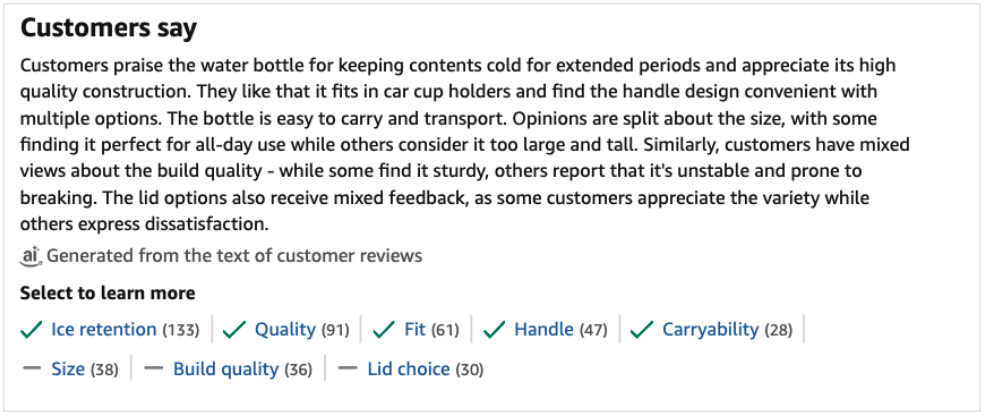
- Negative patterns that become catalog characterizations: If multiple reviews mention the same limitation, Amazon’s AI reads that as a product attribute whether or not it reflects your intent. Address it proactively in a FAQ answer or resolve it and update the listing language.
- Review response example: “Thanks for bringing your HydroVault on your Pacific Crest Trail section hike, it was designed specifically for multi-day outdoor use in variable temperatures, so we’re glad the 24-hour cold retention held up. If you ever want to try the 40oz for longer stretches, it’s built on the same platform.”
Why it works: This review response reinforces trail use, temperature performance, and introduces the 40oz variant — all as indexable text. Generic review responses contribute nothing to catalog depth.
11) Off-Amazon Content Guidance
Off-Amazon Content:
- Brand D2C Website Product Page: Use the same product name (HydroVault 32oz Insulated Water Bottle), same key specs (2.95” diameter, 24hr cold, 12hr hot), and same use-case language (commute, gym, trail). If your website calls it a “travel tumbler” and Amazon calls it a “water bottle,” you are splitting the picture that its search ranking algorithm is using to understand the product. That being said, you don’t necessarily need to use the exact same product titles across all listings (brand voice may be more important to maintain across your website), however the core positioning and information should be reiterated wherever possible for consistency.
- Retail Partner / Reseller Brief: Provide a one-page content syndication sheet with an approved product name, three key claims (temperature, leak-proof, cup holder fit), exact dimensions, and two approved use-case sentences. Most retailer-written descriptions are wrong because brands never gave them the right inputs. Those descriptions enter Amazon’s knowledge graph regardless.
- Press and Editorial Coverage: If a review site uses “great for outdoor adventures” and your listing uses “outdoor” in intended use attributes, the language reinforces each other. You cannot control editorial language entirely, but inconsistent product naming and claim language in press materials will decrease the likelihood of favorable alignment with your brand’s products in the eyes of Amazon Rufus.
Why it works: Every reseller page or retail partner description using different terminology is a small leak in catalog coherence. A content syndication sheet costs almost nothing to produce and quietly cleans up years of fragmented external data.
Summary & Conclusion
The Three-Tier Summary
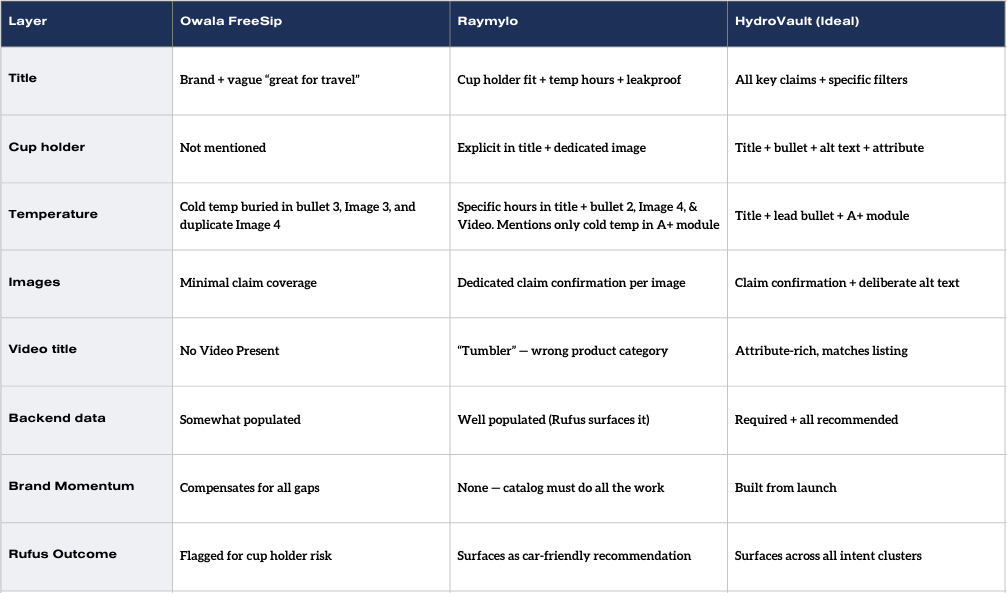
Owala ranks near the top of its category despite product detail page gaps because review mass and years of external validation compensate for what its Amazon listing lacks.
The Raymylo example illustrates the same dynamic from the opposite direction: a brand without much momentum earning Rufus placements in a competitive category. This is a direct result of the brand investing in building the right content into every indexable layer on Amazon. And one fixable video title error is the only thing preventing the brand from obtaining a fully coherent catalog.
The third and best example, HydroVault, maintains consistent product positioning across every content layer on its Amazon listing page. The same story is reinforced, in the same language, across every surface Amazon can read.
Every content field reinforces these pillars, allowing Amazon’s search ranking algorithm to build an increasingly confident picture of exactly what this product is and who it serves:
- Temperature retention.
- Leak-proof reliability.
- Cup holder fit.
- All-day versatility.
Closing Takeaway
Catalog authority is not what makes Owala rank, but it is what will make the next Raymylo break through a category Owala dominates. For brands without Owala’s momentum, catalog architecture is the equalizer. The brands that build this architecture deliberately, before they have the review mass and brand momentum to coast, are the ones that earn placement on merit. That is what catalog authority looks like in practice: specific, actionable, and compounding.