Article
Navigating Amazon’s Compliance Minefield: Mastering Restricted Products, Claims and Keywords
When you’re battling for sales on Amazon, it’s easy to focus only on price and quality. But the real game-changer is staying compliant.
Think of your product listing—every photo, every word—as a reflection of your brand’s trust and commitment to safety. If you ignore Amazon’s strict rules, particularly the ones about restricted items and prohibited claims, you’re inviting disaster. The hammer comes down hard: listings vanish, products get suppressed, and your entire account can suffer penalties.
What are Restricted and Prohibited Keywords, Categories, and Claims on Amazon?
Before we dive into the details of what’s restricted or prohibited, let’s review Amazon’s foundation around content creation, keywords and claims limitations, and certain terminology used by marketplace sellers.
Amazon Product Policy Foundation and Scope
At its core, Amazon wants happy, trusting customers, and that means product listings have to be 100% accurate, transparent, and totally legal. The single, most reliable source-of-truth for these constantly changing rules and regulations is the Amazon Seller Central Official Policies—consider this your definitive guide. Additionally, other regulatory agencies and governing bodies, like the Federal Trade Commission (FTC), keep a very close eye on how products are marketed to prevent deceptive advertising and misleading marketing practices.
The key takeaway: To keep your account healthy and avoid listing issues or content rejection, you need to double-check that every product claim accurately reflects its features. Don’t risk confusing shoppers with language that could be seen as deceptive or misleading.
Amazon’s Restricted and Prohibited Products and Categories
In order to keep its marketplace safe, trustworthy, and running smoothly for everyone—shoppers and sellers alike—Amazon groups products, subject to special policies, into categories based on significant concerns like safety, legal compliance, or ethics.
- Restricted: Products or categories that require Amazon approval/ungating and may necessitate special certifications or documentation before items can be listed in the marketplace.
- Prohibited: Items that cannot be sold because they are illegal, dangerous, recalled products, or are products that require a prescription to obtain.
Understanding Misleading and Prohibited Claims on Amazon (Claims Violations)
Claims are statements that Amazon considers to be either explicit or implied about a product’s feature, performance, or benefits. Ensuring that any claims you present about your products on Amazon are true, accurate, and fully substantiated will help set your catalog up for success.
- Misleading Claims: A misleading claim falsely or deceptively advertises, or uses language that is not directly truthful, to represent a product’s features. Amazon policy prohibits the sale of any product that is misleading about its qualities or characteristics.
- Prohibited Claims: Amazon prohibits claims that violate laws, regulations, or standards established by government agencies, regulatory authorities, or certifying bodies. Amazon policy specifically bans products that include illegal, misleading, or unsubstantiated claims.
Bottom line: Any statement you make about health, safety, or performance must be accurate and you must be able to back it up with documented proof.
Main Amazon Categories Requiring Specific Statements or Disclosures
Part of your Account Manager’s role is making sure every listing in your catalog has the specific keywords, disclosures, or disclaimers that regulators and Amazon require – avoiding any restrictions or prohibited terms and meeting all guidelines. This is your key defense against Amazon product policy violations.
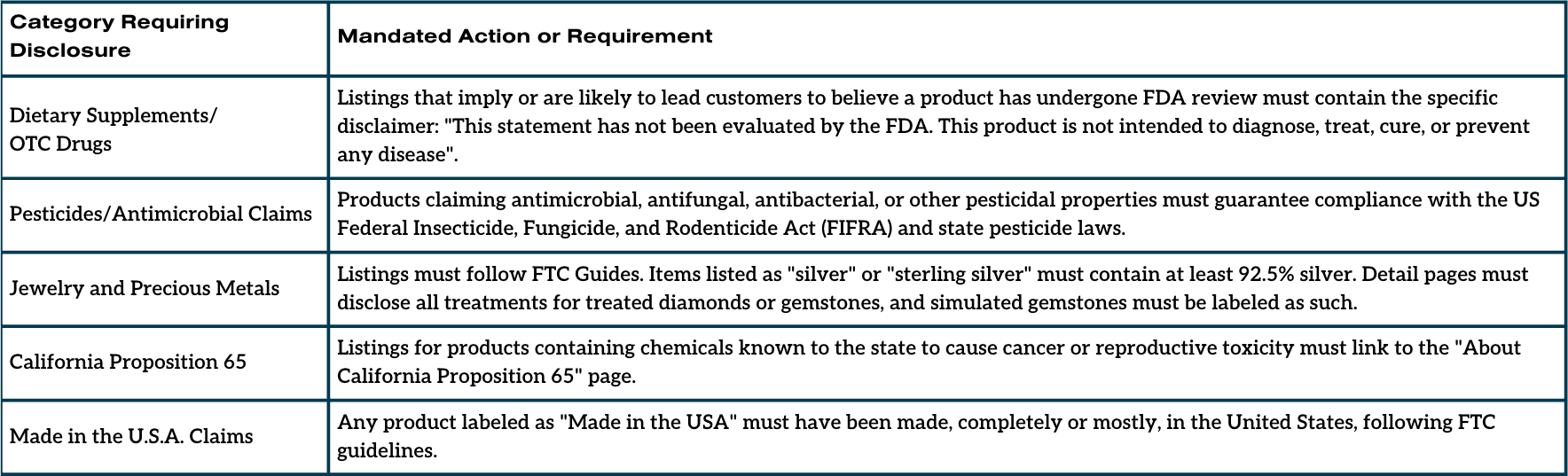
Below, we’ve broken down some of the main Amazon product categories where compliance is a crucial issue:
- Dietary Supplements/OTC Drugs: Listings that imply or are likely to lead customers to believe a product has undergone FDA review must contain the specific disclaimer: “This statement has not been evaluated by the FDA. This product is not intended to diagnose, treat, cure, or prevent any disease”
- Pesticides/Antimicrobial Claims: Products claiming antimicrobial, antifungal, antibacterial, or other pesticidal properties must guarantee compliance with the US Federal Insecticide, Fungicide, and Rodenticide Act (FIFRA) and state pesticide laws.
- Jewelry and Precious Metals: Listings must follow FTC Guides. Items listed as “silver” or “sterling silver” must contain at least 92.5% silver. Detail pages must disclose all treatments for treated diamonds or gemstones, and simulated gemstones must be labeled as such.
- California Proposition 65: Listings for products containing chemicals known to the state to cause cancer or reproductive toxicity must link to the “About California Proposition 65” page.
- Made in the U.S.A. Claims: Any product labeled as “Made in the USA” must have been made, completely or mostly, in the United States, following FTC guidelines.
Avoid Restricted “Hot Button” Keywords to Keep Your Amazon Listings Healthy
Using certain keywords—especially those tied to health, safety, or subjective performance—are restricted and can instantly flag your Amazon listing for review, leading to content rejection or suppression altogether. It’s a fast track to problems that nobody wants to encounter.
To keep your Amazon listings healthy, you should actively avoid using any restricted “hot button” keywords. While this is not a complete and exhaustive list, we’ve highlighted some of the top restricted keywords that are known to automatically trigger a product listing for noncompliance review on Amazon:
Health, Disease, and Medical Claims Prohibited on Amazon
When dealing with anything that touches health or medical issues, Amazon’s product policy is uncompromising, and it makes complete sense—they have to protect shoppers.
The Rule: Amazon strictly prohibits language that suggests a product can diagnose, cure, mitigate, treat, or prevent a disease in humans or animals without official FDA approval:
- Disease/Condition Names: Avoid listing ANY disease name. Specific examples include AIDS, Cancer, COVID-19, Diabetes, Dementia, Anxiety, Flu, Herpes, HIV, Lupus, Parkinson.
- Medical/Treatment Language: Cure, treat, treatment, heal, remedies, remedy, Fast Relief.
- Microbial/Pesticidal Claims: Anti-bacterial, Antibacterial, Anti-Microbial, Antimicrobial, fungal, fungus, Fungicide, pesticide, pesticides, sanitize, sanitizes, viral, virus, viruses.
- Body/Weight Claims: Weight loss, detoxification, detoxify, Keto.

Promotional, Subjective, and Pricing Claims Prohibited on Amazon
Amazon flags subjective and promotional keywords quickly, with the marketplace’s policies restricting what you can say about pricing and fulfillment (those details must be managed by Amazon’s system, not your listing copy).
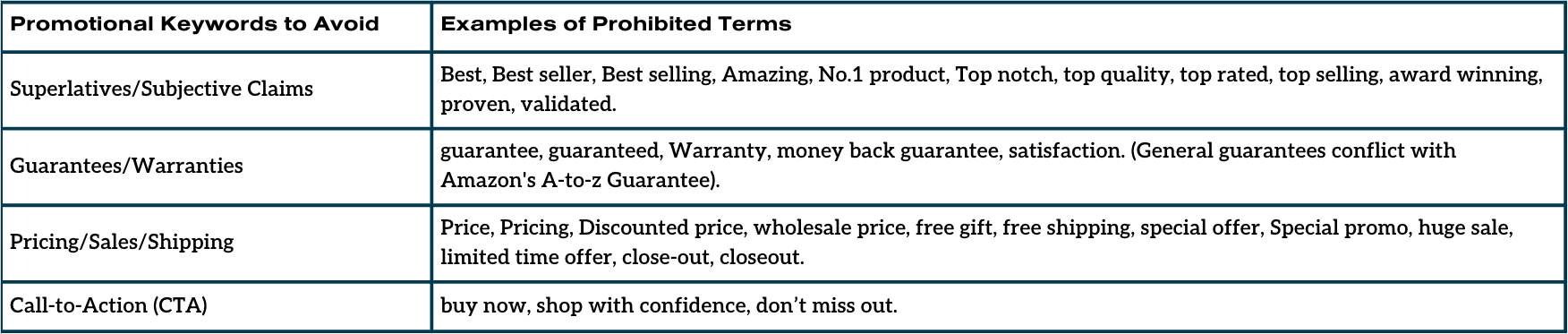
The Rule: Avoid language that is subjective, promotional, or relates to pricing, fulfillment, or competitor referencing:
- Superlatives/Subjective Claims: Best, Best seller, Best selling, Amazing, No.1 product, Top notch, top quality, top rated, top selling, award winning, proven, validated.
- Guarantees/Warranties: Guarantee, guaranteed, Warranty, money back guarantee, satisfaction. (General guarantees conflict with Amazon’s A-to-z Guarantee).
- Pricing/Sales/Shipping: Price, Pricing, Discounted price, wholesale price, free gift, free shipping, special offer, Special promo, huge sale, limited time offer, close-out, closeout.
- Call-to-Action (CTA): Buy now, shop with confidence, don’t miss out.
Safety, Environmental, and Product Compliance Claims Prohibited on Amazon
These claims are usually the ones that involve outside regulatory agencies (like the EPA or specific safety bodies). Because of that, Amazon treats them with extreme seriousness. You’re dealing with consumer trust and legal risk here.
The Rule: Any claims you make that are absolute (e.g., “100% safe,” “completely organic”, etc.) or that reference official regulatory bodies must be strictly verifiable and require specific documentation that you need to be able to provide upon request:
- Official Approvals: FDA, FDA Approval, FDA Approved, certified, approved.
- Absolute Claims: 100% natural, 100% quality guaranteed, non toxic, non-toxic, Harmless, claims of purity like 100% all-natural.
- Environmental Claims: Eco friendly, eco-friendly, ecofriendly, green, biodegradable, compostable, degradable, environmentally friendly.

Intellectual Property and External References
This is all about protecting yourself and respecting the marketplace boundaries: You can’t use someone else’s legally protected material, and you can’t use your listing to send customers away from Amazon. Violating this can lead to immediate, severe legal action from brand owners or Amazon itself.
Naturally, Amazon wants to keep customers on its platform, so adding something like a link to your D2C website or company’s phone number is prohibited on your detail pages.
The Rule: Sellers cannot leverage competitors’ Intellectual Property (IP), copyrighted material, or attempt to redirect customers off Amazon through external links or references in their listings:
- External Links/Contact: Web links, external URLs, phone numbers, emails, QR codes (in any image or text). Specific carriers like UPS or FedEx.
- Competitor References: Direct comparison to competitors, competitor brand names (unless using an Amazon-approved compatibility tool).
- Testimonials/Reviews: Reviews, Feedback, Customer reviews, quotes from individuals or customers, unverified endorsements.
- Unauthorized Claims: Native American Indian or tribes or indian if incorrectly implying origin.

Important Notes for Images (Listing Images, A+, Brand Store)
Last but certainly not least: Restrictions aren’t just relevant to the keywords you add into your Amazon listing copy.
Visual assets, including your main product images, secondary photos, A+ Content, and Brand Stores, are held to the exact same strict compliance standards as written text.
- Visual Claim Restrictions: Avoid using images that show medical transformation (e.g., before-and-after weight loss claims) or images that include unsubstantiated certifications or logos.
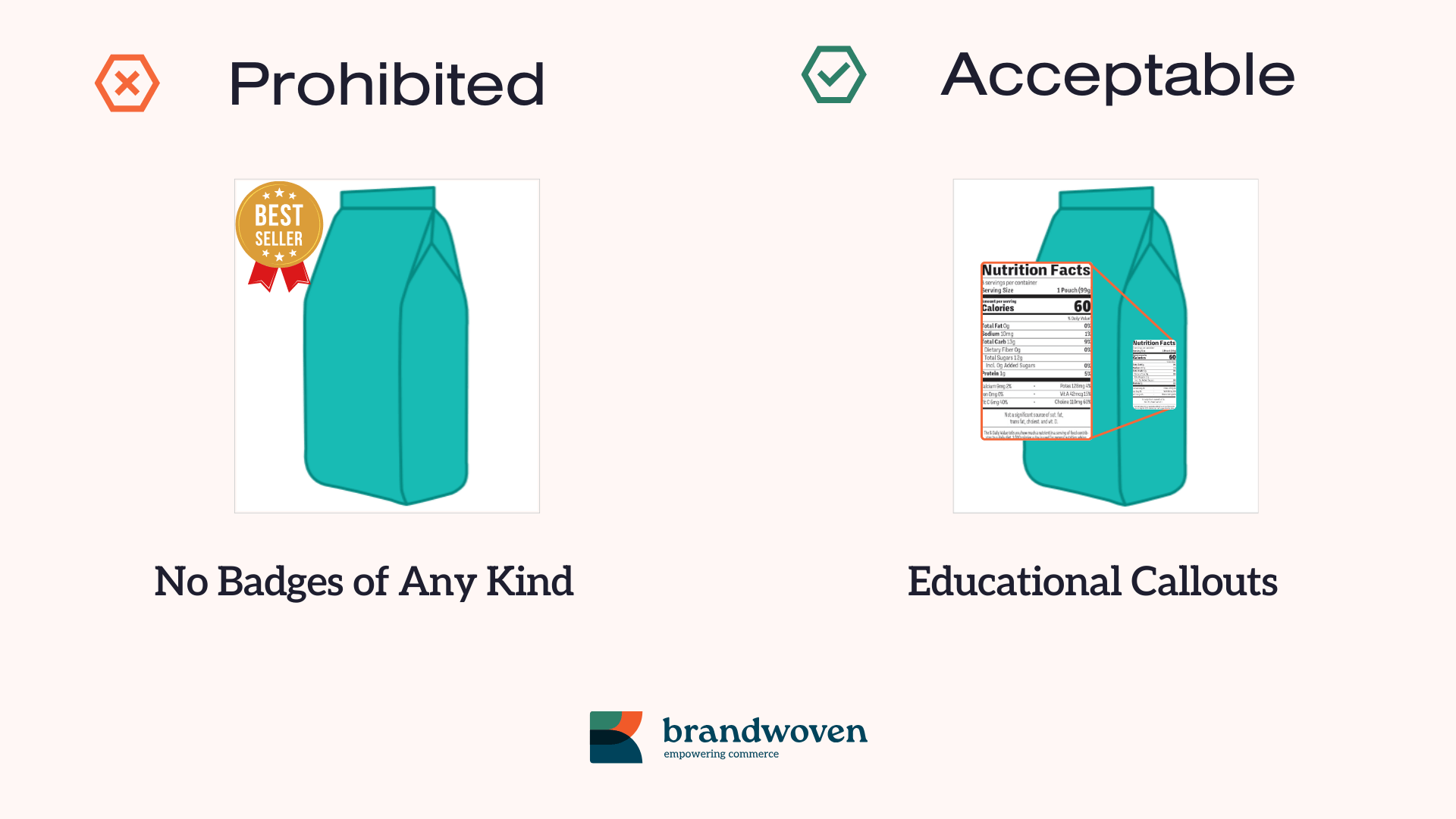
- Avoid “Badges” and Overlays: Do not use any form of “badge” or overlay to advertise sales, discounts, or awards (e.g., “Best Seller” or a large “#1 Best Seller” badge).
- No External Redirection: Images cannot contain watermarks, QR codes, links to external sites, or contact information like phone numbers or emails.
- A+ Content Image Guidelines: All the text embedded in A+ images and the corresponding alt-text must comply with all Amazon keywords/claim restrictions (any prohibited terms in your copy are also prohibited in your imagery). Additionally, do not reuse the main product gallery images in your A+ Content.
- Intellectual Property (IP): Avoid the unauthorized use of third-party brand logos, copyrighted images, or public figures’ photos/quotes (without permission).
- Quality and Clarity: Images that are blurry, low-quality, or contain small, unreadable text are often rejected.
- Registration® and Trademark™ Symbols: While having the registered mark is a requirement to sell under a brand on Amazon, showing the registration symbol is prohibited in the customer-facing content. Strictly avoid including the registration or trademark symbols in your product title, bullet points, or description text. These symbols are highly regulated and their use in any listing element frequently causes ASIN suppression or publication delays.
Although Amazon has strict guidelines about what you can say or show in your product page imagery, this is different than a best practice we recommend: Adding helpful, educational callouts to your listing images. For example, a clothing brand visually displaying their size chart or a beverage brand zooming in on their nutritional facts panel is allowed.
Final Note
The reality is that the world of ecommerce is always changing, and Amazon’s policies are constantly being updated. Because of this, continuous monitoring (weekly and monthly) and strategic content optimization are absolutely essential; your work is never truly “done.”
While this guide provides a solid informational foundation, we always share one crucial piece of advice: To truly maximize your success and ensure full product compliance, you must regularly refer to the official Vendor/Seller Central policies via the Amazon marketplace portals. That is the only way to get the most up-to-date, completely detailed policies and best practices directly from Amazon.