Introduction
If you’re managing your brand in-house without expert guidance, it might be time to upgrade.
Maybe you understand the basics but need expertise to scale, optimize operations, or solve specific challenges like reseller management or multi-marketplace strategy.
Ecommerce consulting acts as a solution to this problem, offering specialized strategic guidance that translates marketplace complexity into measurable outcomes. For example, at Brandwoven, our brands grow at a rate significantly higher than their peers on Amazon. In 2024, our partners saw an average of 24% year-over-year growth.
In this article, we will explain what ecommerce consulting looks like in practice, how specialized marketplace consultants help brands optimize Amazon, Walmart, Target, and Instacart operations, and provide a framework for evaluating consulting partners to drive measurable growth. Keep reading to learn how this consultative approach differs from in-house management and how to pick the right partner for your brand based on which services are most important to your team.
What Is Ecommerce Consulting?
Ecommerce consultants offer specialized advisory and execution services to help brands optimize online sales operations.
Marketplace vs General Ecommerce Consulting
General ecommerce consulting usually focuses on D2C websites or even digital marketing like the technical expertise needed to keep your site up and running.
Marketplace consultants are a specialized team under this umbrella who understand platform-specific rules, algorithms, and content requirements. In the marketplace space (where our agency focuses) we particularly work on scaling growth across major online platforms like Amazon, Walmart, Target, and Instacart.
For example, Amazon has character limits for product titles whereas on your own website you can write as much as you want. Pair this with the challenge of selecting and targeting the right SEO keywords for the specific marketplace’s shopper behavior while balancing your brand voice, and all of a sudden your marketplace listing strategy requires a much more detailed and “strict” approach than that of your D2C site.
When Brands Typically Seek Consulting Support
Brands hire consultants for a variety of reasons, including:
- Lack of internal expertise
- Resource constraints
- Need for specialized platform knowledge (eg: Vendor Central vs Seller Central)
- Desire for unbiased outside perspective
The consultant takes on the role of strategic advisor + hands-on operator, translating data into action, managing day-to-day account mechanics, and connecting tactics to business outcomes.
Core Ecommerce Marketplace Consulting Services
When partnering with an ecommerce consultant, especially if looking for marketplace-specific help, the consultant’s service stack should include the following:
- Account Management & Catalog Optimization
- Advertising & Paid Media Management
- Data Platforms & Reporting
- Strategic Planning & Roadmapping
- Reseller Management & Brand Protection
- Digital Merchandising
- Logistics & Forecasting
Each of these areas is a specific skillset; the mistake brands make is to assume one single person can be good at all of them.

Marketplace Account Management
This covers all of your day-to-day operations like launching new items, dealing with suppressions or compliance, and assuring orders are flowing. If you’re active across multiple marketplaces, like Amazon and Walmart, this should also cover catalog management and content optimization for each channel’s listings.
Account management services might also include consulting on your pricing strategy (making sure you remain profitable while running promotions) and, importantly for marketplace accounts, buy box monitoring. We have a whole guide on how the Amazon buy box works, if you want to learn more about that.
Advertising & Performance Marketing
Tying into the pricing strategy mentioned above is how much money a brand invests in advertising and driving paid traffic to their listings. On marketplace, platform-specific CPCs can vary and spike especially around times like Prime Day.
Beyond the high-level advertising strategy and budget management is the campaign setup, ongoing bid optimization, KPI tracking, keyword targeting strategy, placement selection, and more.
Performance marketing is an area where the wrong investment can leave a huge hole in your brand’s pocket – so whether you have someone in-house or are working with a consultant, it’s best to partner with someone who has marketing experience in your category.
Data & Reporting
Ecommerce consultants may provide proprietary dashboards and should, at minimum, assist with performance analysis and competitive intelligence. The core of this service comes down to extracting actionable insights from the sea of data and reports that Amazon provides sellers and connecting the most important metrics directly to better business decisions.
Strategic Planning
Any ecommerce consultant should assist with strategy – but the best consultants can help with complex situations such as:
- Multi-marketplace management
- Channel distribution planning
- International expansion
- Go-to-market frameworks for new products
Reseller & Brand Protection
Reseller monitoring, enforcement, and management is a beast of its own and a challenge that many brands, especially those on marketplace, face. To make matters more complicated, this is rarely ever a one-and-done situation; it requires constant monitoring of unauthorized sellers and ongoing policy enforcement. To get into the nitty gritty of what a successful reseller management program looks like, download our guide.
Operational Optimization
Everyday operations are the final core area where consultants can step in to assist your team. If your brand has a particularly large catalog (10K+ ASINs), considering navigating a platform transition (eg: Vendor Central to Seller Central), switching fulfillment methods, or even just looking for additional help with forecasting and inventory planning, these are all areas where an operational expert can be of great help.
Why Hire an Ecommerce Consultant?
So far in this article, we’ve already gotten into a few areas where a consultative partner can make a huge impact on your brand. So, if you’re considering hiring a consultant, the question might come down to “is it worth it?” and how to actually measure the ROI of that decision. The answer varies depending on how many issues you need help with, but consulting investment usually pays for itself through revenue growth and operational savings. For example:
- Year-over-year sales growth
- Improved buy box rates
- Higher conversion rates, especially during peak periods
- Improved advertising ROAS
Our Impact at Brandwoven
Ad Conversion Rate Across All Managed Brands, Up YoY
YoY Increase in Ad Sales Per Click Across All Managed Brands
YoY Increase in Ad Clicks Across All Managed Brands
YoY Increase in Ad Click-Through Rate Across All Managed Brands
Average YoY client sales growth
Average conversion rate of Brandwoven clients above industry average
Average Client Buy Box
In-stock Rate
Investing in an Ecommerce Marketplace Consultant
Brands typically invest in ecommerce consulting when they are looking for:
- Measurable business outcomes
- Expertise they don’t have the ability to build in-house
- Want faster speed-to-results
Unlock Stagnant Growth
Consultants identify hidden opportunities in catalog structure, content quality, advertising efficiency, or channel strategy that internal teams miss due to bandwidth or expertise gaps.
Access Specialized Expertise
Marketplace algorithms, platform policies, and best practices change constantly. Consultants stay current across 16+ online marketplaces so that you don’t have to. Wondering what the current state of a certain policy is or what’s expected to change over the next few months? Just ask.
Gain Operational Efficiency
Consultants implement systems, processes, and technology that reduce manual work and improve decision speed.
Achieve Faster Results
Experienced consultants have seen your challenges before. They know what works – and what doesn’t – and how to implement proven solutions immediately versus expensive trial-and-error.
Receive Unbiased Strategic Guidance
External consultants provide an objective assessment of what’s working and what’s not, without internal politics or bias. We’ll give it to you straight and tell you what’s driving revenue versus leaking budget.
How to Choose the Right Ecommerce Consultant for Your Brand
Choosing the best partner for your brand depends on both what your needs are and which areas the consultant’s expertise lies in. Use this evaluation criteria to help make an informed decision:
- Platform-Specific Expertise – Do you need to know exactly how Walmart works?
- Proven Results & Track Record – Have they helped similar brands in the past?
- Technology & Data Capabilities – Will they provide a regular reporting cadence to keep you on track?
- Engagement Model & Partnership Approach – Do their offerings, cost, and communication expectations match yours?
Operator Experience
Have they actually run marketplace accounts at scale, or just advised at a high-level? There is no right or wrong answer – just what your team is specifically looking for.
We highly recommend partnering with consultants that have a history of brand-side or hands-on operational experience, not just an agency background. This unique perspective gives the consultant an upper hand on everyday challenges that a high-level strategist might not even think of.
This also ties into category expertise. Do they understand your product category’s unique challenges (eg: large catalogs, complex variations, regulatory requirements, seasonal patterns, etc.)? This is an especially important consideration if you sell hazmat goods.
Results & Social Proof
Ask for specific metrics (YoY growth rates, buy box improvement, conversion lifts, etc.) from past projects – particularly those from similar brands if available. Also ask for case studies or testimonials from your specific category as additional social proof.
Client retention is also a helpful metric to ask about. How long do their clients typically stay? 3+ year retention indicates real partnership versus transactional relationships.
Service Model Clarity
Will the consultant only offer advice, handle full-service execution, or a hybrid approach (strategy + execution)? Understand what you would actually be getting if you partnered with them.
Another question to consider here is how custom their approach is. Some consultants literally go through a checklist – that’s it. Others start with a consultation, learn about your specific challenges, then build a custom solution that fits your needs. If the latter sounds more like what you’re looking for, we encourage you to schedule a no-obligation call with our team.
Common Examples of Ecommerce Consulting Projects
Here are a few concrete examples of projects that our ecommerce consultants have tackled to help you identify whether any of these needs match yours:
- Platform Transitions & Migrations – migrating from Amazon Vendor Central to Seller Central (or vice versa), maintaining sales continuity during the transition, and optimizing the new model.
- Multi-Marketplace Strategy & Management – deciding when and how to launch on another marketplace (eg: Amazon to Walmart), adapting strategy for each platform’s unique requirements, and managing unified inventory, pricing, and promotions to avoid negative impacts to other channels or causing loss of buy box.
- Reseller Enforcement & Brand Protection – identifying unauthorized sellers, enforcing MAP/UPP policies, reclaiming the buy box from bad actors, protecting brand content, partnering with legal teams, implementing tracking software, etc.
- Large Catalog Optimization – managing 10K+ ASINs across multiple marketplaces, improving content quality at scale, automating catalog updates, etc.
- Advertising Performance Improvement – restructuring campaigns, improving ROAS, scaling ad spend profitably, implementing advanced targeting strategies, etc.
- International Expansion – launching in other markets (eg: Amazon Europe), navigating cross-border logistics and compliance, adapting content for local markets, translations, etc.
More established brands may focus on the reseller and expansion phases whereas growth-stage brands may only require catalog and advertising setup.
Ecommerce Consulting vs Other Options: Should You Build In-House?
Consultants vs In-House Teams
Consultants bring immediate expertise and avoid hiring/training costs, but in-house teams offer dedicated focus and institutional knowledge.
The reality is that, for very large brands, the best approach is often hybrid (consultant + lean internal team). We’ve also seen many brands expand both ways (start in-house then realize they need external help, or partner with a consultant upfront and gradually bring in dedicated personnel).
Consultants vs Freelancers
Freelancers often offer lower costs but can only work within a limited scope and capacity. On the other side, consultants bring a team-based approach and a comprehensive service stack. It comes down to whether you are looking for a quick fix on a specific thing or a long-term partner to help you grow sustainably.
How the Consultants at Our Full-Service Agency Work
Brandwoven focuses on both strategy and execution; we help identify the core problems, build a plan to fix them, and actually execute the work needed to get there.
We also bring deep platform expertise and brand-side experience across every department: advertising, logistics, content creation, catalog setup, and everyday account management.
Summary of Who to Hire for Your Brand
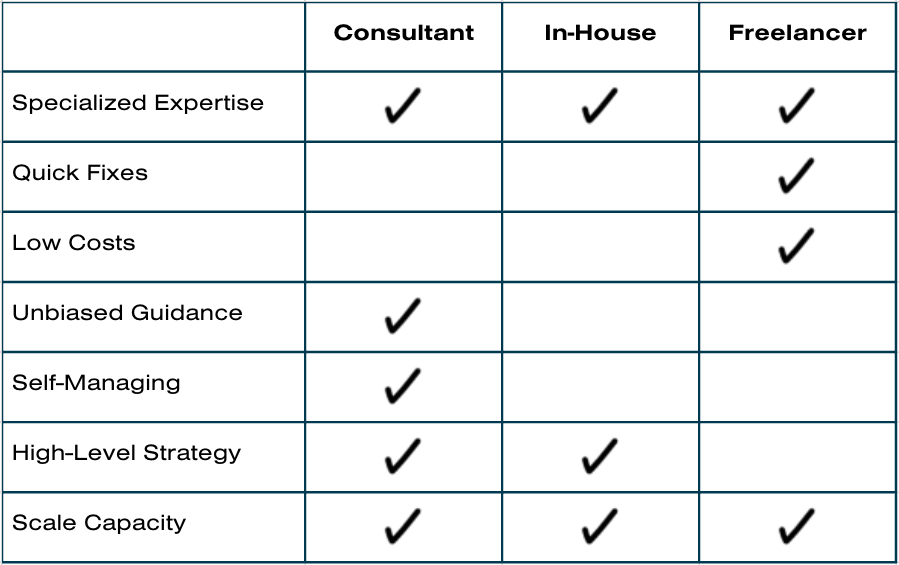
What to Expect When Partnering with a Consultant: Timeline to Results
If partnering with an ecommerce consultant, they should be setting realistic expectations for your engagement upfront. It comes down to:
- Whether you expect short-term wins VS looking for a long-term growth partner
- How you’re measuring consulting ROI
- What your marketplace goals are and what you define as “results”
Here is a general timeline of what you can expect (but again, this depends on whether you are just engaged in a consulting-based partnership or whether you’ve hired services for execution as well):
- Quick Wins (30-60 days): Minor fixes or changes depending on account status and number of products.
- Minor account fixes/setup
- Minor catalog fixes (case work)
- Minor content upgrades (if full rewrites or images are needed then optimization may take longer; this also depends on how many assets your brand already has and if additional photos or brand guides are needed)
- Advertising campaign audit (if looking for full restructuring of ads, this can take longer to build)
- Strategic Improvements (90-180 days): Changes that require more time upfront but deliver sustainable growth.
- New product launches
- Large-scale catalog or digital merchandising optimization (can take longer depending on number of ASINs)
- Transformational Results (6-12+ months): Complex initiatives with compounding long-term value.
- Reseller policies and management programs
- Expansion into new markets or platforms
In our experience, as this timeline progresses, many brands choose to invest further: expanding from a one-time consultancy project to an ongoing annual retainer. Most brands find that, since ecommerce is always changing, having a partner who is always there to help is worth it for continuous improvement.
Conclusion & Key Takeaways
Experienced ecommerce consultants help brands optimize marketplace operations, drive measurable growth, and solve complex challenges. The main benefits include access to specialized expertise, faster results than building in-house, and measurable ROI through revenue growth and operational efficiency that compounds over time.
If you’re seeing plateaued growth, struggling with the complexities of everyday account management, or lacking internal expertise for specific challenges your brand is facing, consulting can unlock your next growth phase. As a next step, let our team evaluate your current marketplace performance and recommend the best fit for you.