Amazon Listing Advice is Getting Harder to Evaluate
With so much new Amazon listing advice circulating — from Seller Central updates, AI speculation, and overnight “experts” — how do brands decide what ideas can actually be trusted?
Brands are hearing more advice than ever, but not all advice has the same level of evidence. Some guidance is Amazon policy, some is proven best practice, and some is emerging/testing territory. Brands are doing more evaluation than ever by trying to figure out which strategies are worth testing, which PDP content is worth changing, and which rumors should just be ignored when it comes to “optimizing for AI.”
That’s why we put together this article, providing you with an actionable framework for how to evaluate listing content advice in this new AI-focused environment. We’ll walk through:
- What has Amazon actually confirmed
- What is widely considered best practice
- Emerging AI optimization trends to watch
- How to decide whether new AI learnings are worth testing versus ignoring
For a broader view of Amazon listing page optimization across operations, catalog, content, and velocity levers, see our complete guide to Amazon listing optimization.
Listing Content Policies Amazon Has Directly Confirmed
Before we get into specific PDP content policies, let’s quickly go over Amazon’s investment in AI shopping and how it has started to change customer behavior and brand strategies.
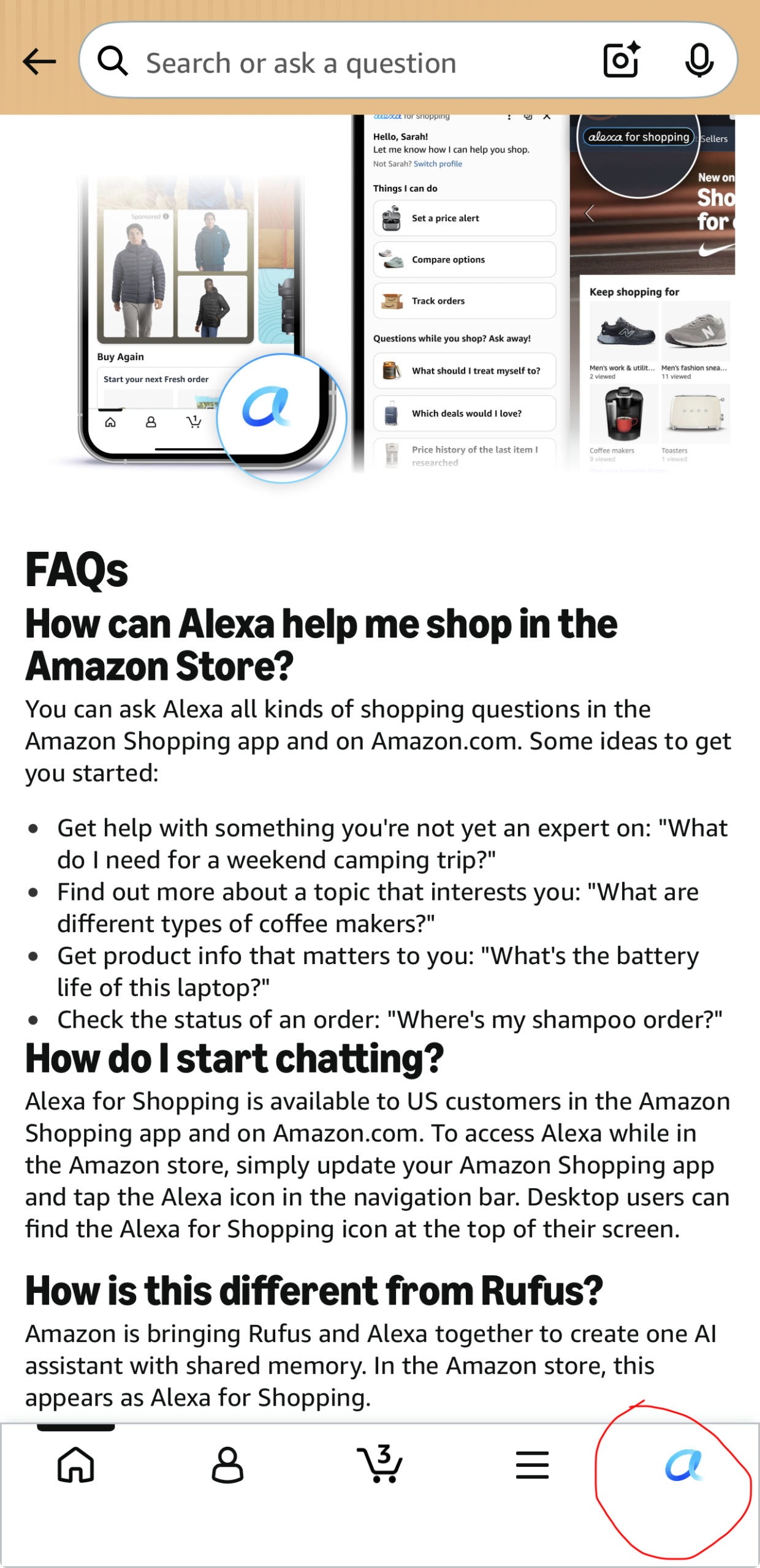
Amazon’s AI Chatbots Are Here to Stay: Rufus & Alexa for Shopping
We’ve talked a lot about how Rufus has been impacting brands on the marketplace for the past couple of years, ever since Amazon first announced the AI shopping assistant in early 2024.
Despite Amazon boasting Rufus success last year, the company recently rebranded the AI chatbot to “Alexa for Shopping” which integrates with its Echo home devices that are now owned by more than 20% of the US population.
Using personal information Alexa has already obtained about a user, combined with their product search and history, it recommends items based on factors like price, differentiation, and reviews. Alexa for Shopping can also manage a user’s cart for them and remembers all of this information, across every purchase and chat, to improve recommendations over time and ultimately speed up time-to-conversion.
How Amazon AI Shopping Ties into Listing Page Content Strategy
Knowing that Amazon is continuing to invest further in AI shopping assistants and that this is beginning to fundamentally change how consumers discover products (thus impacting SEO and paid ads), brands are now being put in a tough, new position: Does the approach to PDP content need to change?
Before saying “yes”, let’s review the confirmed Amazon content policies that exist today:
- Product Titles
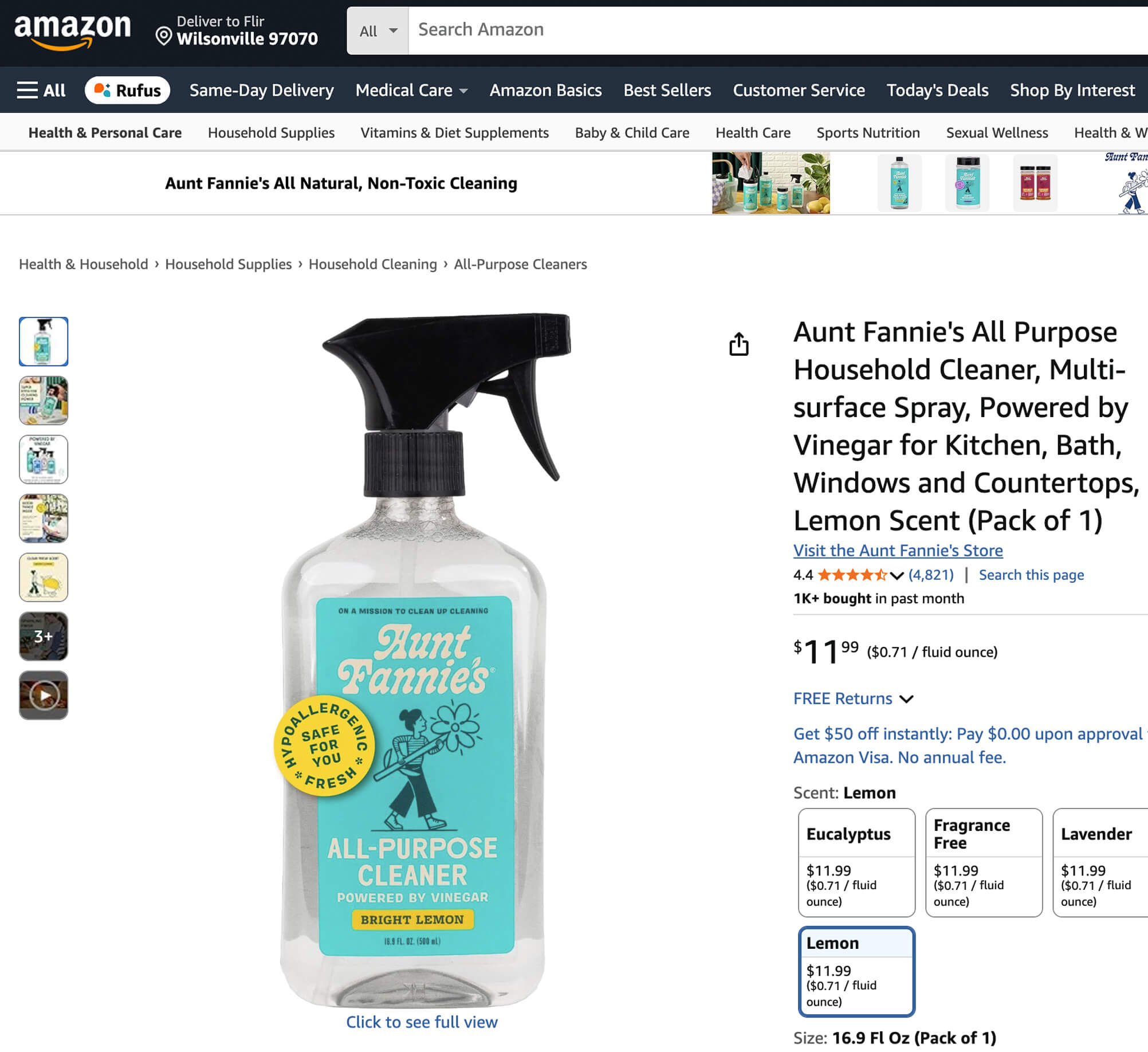
- Amazon recently changed product title guidelines to 75 characters max (minus Apparel which is 125 max, and media product types). This change may lead to suppression of existing products with >75 characters if not manually corrected by the brand. The switch aims to prevent mobile layout breaking and improve the customer experience by making it easier for shoppers to quickly understand what products are when scrolling the search results.
- Include the brand name at the beginning of the product title
- Avoid redundant wording or special characters
- Bullet Points
- Start each bullet with a capital letter
- Include at least 3 bullets with a 10-character minimum per bullet
- Do not include any punctuation at the end of the bullet point or special characters
- Avoid restricted keywords or claims
- Images & Videos
- Each Amazon listing requires at least one image on a pure white background at minimum 500 pixels
- Fill at least 85% of the (main) image with the product
- Avoid Amazon-related terms
- Backend Search Terms
- Only use lowercase letters
- Do not include punctation marks, brand names (yours included), ASINs, or subjective claims
Aside from these specific guidelines, there are also tons of best practices on how to write and design listing page content to resonate with buyers.
General Amazon Best Practices Recommended for Every Brand
Any successful Amazon brand is likely going far beyond the technical guidelines of the marketplace by building out comprehensive, eye-catching, and educational listings.
Here is what’s recommended for every Amazon brand:
- Balance shopper intent with readability in product copy.
- When writing product copy, position your product as a solution to a specific problem. This framing will tell both shoppers and AI bots that the item fits the customer’s need.
- Treat imagery as a conversion asset.
- Use listing images and A+ Content to present structured product information. Quickly communicate use cases, product size/scale, any differentiators, and compatibility (if applicable).
- If including any text in your images, follow the same guidelines as you would with regular PDP copy (i.e. verify claims and ensure compliance). Statements made in images should match those in the copy and attributes (eg: if you sell a carpet cleaner that should not be used with vacuums, do not include an image of someone vacuuming on the listing).
- Build consistency across every asset.
- The product title, bullets, images, A+ Content, backend attributes, Brand Store, and related off-Amazon content should not contradict each other. Inconsistent product data can create shopper confusion and potential compliance risks.
- Review and refresh content based on performance signals.
- You can plan to do this quarterly or watch for triggers such as:
- Declining rank/CVR
- New competitor products
- New keyword opportunities
- New customer questions/reviews
- Amazon policy updates
- New season
- New product claims (potential compliance risk)
- New product use cases
- Evident AI (Rufus/Alexa for Shopping) visibility gaps
- You can plan to do this quarterly or watch for triggers such as:
Emerging Trends to Watch & How Much Weight to Give Them
There have been a number of emerging claims about how Amazon’s algorithm works and what changes brands need to be making to their listings as a result. Many of these are worth testing but require validation based on your brand’s category and performance data before being considered a universal Amazon policy (as the company has yet to confirm any of these changes).
| Emerging Trend | If True, What It Means for Brands | Our Take | How To Test It |
|---|---|---|---|
| AI shopping assistants may be changing how listings are interpreted | You will need to change how you write about your products on Amazon | This is directionally credible. Amazon has publicly positioned Rufus (and now Alexa for Shopping) as generative AI shopping assistants trained on the marketplace’s product catalog, reviews, Q&A, and external web information. The exact ranking mechanics are not public, so brands should avoid treating every “Amazon AI optimization” claim as proven | Audit whether your PDP clearly answers shopper questions across the title, bullets, images, A+ Content, attributes, reviews, and Q&A content. |
| Early launch performance may matter more as AI systems learn which products are relevant | Treat launch content as more than a starting point. All product information needs to be completely filled in, compliant, and as customer-relevant as possible to capture strong signals early. This will shape how confidently your product is understood and recommended by AI | Early performance has always mattered on Amazon, so this is not purely an AI-related idea. What’s changing is that incomplete or unclear catalog content may now create problems across both traditional search and AI interpretation. That said, brands should not rush any keyword stuffing, copywriting, or other content updates just to “feed the algorithm” | Use a pre-launch checklist to ensure titles, bullets, images, A+ Content, backend fields, attributes, claims, and mobile presentation are aligned, on-brand, and accurate before the ASIN goes live. As changes are required on existing ASINs, consider how much case work/Amazon support is required to push through updates |
| Your first few bullet points may matter more as AI prioritizes interpreting what is listed higher on the page | Put the most important search terms, product details, benefits, and use cases earlier in your bullet points | This is directionally sound even without treating it as a proven AI ranking factor. Front-loading bullets is already good for mobile readability and shopper skimming. The goal should be clear, useful, shopper-first bullets that also include relevant search language | Review and revise bullet order on priority ASINs by moving use cases and benefits into the first one to three bullets |
| The order of your carousel images may influence how well the product is understood and recommended by AI | Treat the image carousel as a structured product story, not just a collection of assets. A stronger example includes: main image, scale, key benefit, use case, comparison, specs or compatibility, proof, and video | Image sequencing is already important for conversion, especially on mobile. The AI-specific impact is still emerging and should not be treated as confirmed Amazon policy. However, building a clearer carousel is low-risk and will likely result in improved shopper understanding of the product, and a potentially higher CVR | Review and revise your carousel sequence on top ASINs. Run an A/B test to track CTR and CVR changes over a 2-3 week period to see whether results improve |
| Image text overlays may matter more in an AI-assisted shopping environment with them becoming “machine-readable” | Any text included in listing images means more as it will be used as a resource when shoppers ask Alexa about your product | This is plausible and worth watching | Review top ASIN image overlays for claim consistency and potential compliance risk |
| Short vertical video may influence AI-assisted product discovery as clips that explain functionality are now viewable by machines | Similar to imagery, your product videos need to be factually accurate and avoid certain keywords/claims that could lead to listing suppression. You must also consider how complementary the video content is to your listing page imagery and copy to ensure consistent product information across all assets | Amazon has not explicitly stated this is true, however it is inferred from the company’s use of its Nova model for internal applications. The more recent Nova 2 upgrade can directly analyze videos. If Amazon is using its Nova 2 model on the marketplace, all videos should be considered readable by the platform’s AI. Regardless, Amazon already recommends brands use video as part of their listing content, so testing short functional videos is reasonable even without tying into AI optimization specifically | Add videos to ASINs where use cases, assembly, fit, scale, or functionality is harder to communicate through static images alone |

Don’t Let GEO Experiments Undermine Your Amazon SEO Foundation
As AI-assisted shopping grows, it is easy to overcorrect toward tactics that sound optimized for Rufus/Alexa or other conversational shopping experiences. But standard Amazon search is still the primary discovery path for most shoppers and categories. Brands should continue building listings that perform well in traditional lexical and algorithmic search before making speculative changes for AI discovery.
In most cases, strong SEO and strong GEO are not mutually exclusive. Clear titles, commonly searched phrases, accurate backend attributes, consistent product claims, helpful images, and well-structured catalog data all support both search visibility and AI readability. The risk comes when brands chase trendy AI optimization tactics that weaken the fundamentals — for example, removing valuable SEO terms, moving toward vague natural-language copy, or making image and A+ Content updates that initially sound useful for AI but later create compliance, indexing, or conversion issues.
The strongest approach is additive: protect the Amazon SEO foundation first, then gradually test AI optimizations that may improve clarity, completeness, and customer relevance. GEO should expand the listing strategy, not replace the proven keyword and catalog practices that are still driving discoverability today.
Decision Framework: How to Evaluate Amazon AI Optimization Tips
As a practical takeaway from everything we’ve covered in this article, use this simple framework when you hear about any new Amazon AI optimization tips before you decide to make any changes to your listings:
- Is it a confirmed Amazon policy? Add it to your internal SOPs to ensure ongoing compliance.
- Is it generally considered Amazon best practice? Add it to your content standards, but you don’t need to strictly follow it.
- Is it supported by data? Rumors are more trustworthy when supported by data, but any changes you make should still be based on their expected impact. Test first before applying recommendations to all listings. Prioritize selection based on factors like category and price point.
- Is it anecdotal or unsupported? Monitor for additional updates before considering as fact. Do not rush to publish changes as a result.
Your decision-making should come down to what is proven as fact or generally considered trustworthy across the industry.
Building a Scalable Content System for Amazon AI
Don’t focus on checklists of hacks you see online to guide your brand on Amazon. Chasing all of these ranking rumors will lead your team to burn out, misaligned objectives, and constant reworking of content that was probably fine as it was.
To succeed on Amazon, brands need repeatable, scalable systems that help them ensure compliance, valuable content, catalog consistency, and on-brand creative – while still allowing room for testing when necessary. The goal is to build product pages that shoppers, search algorithms, and AI bots can all clearly understand.
Amazon listing advice is changing fast. If your team is unsure of what to do next, Brandwoven would love to help evaluate your PDP copy, catalog data, images, backend fields, and overall marketplace strategy to determine the best path forward. Connect with our team or explore our Amazon GEO capabilities to learn more about how we approach AI optimization.