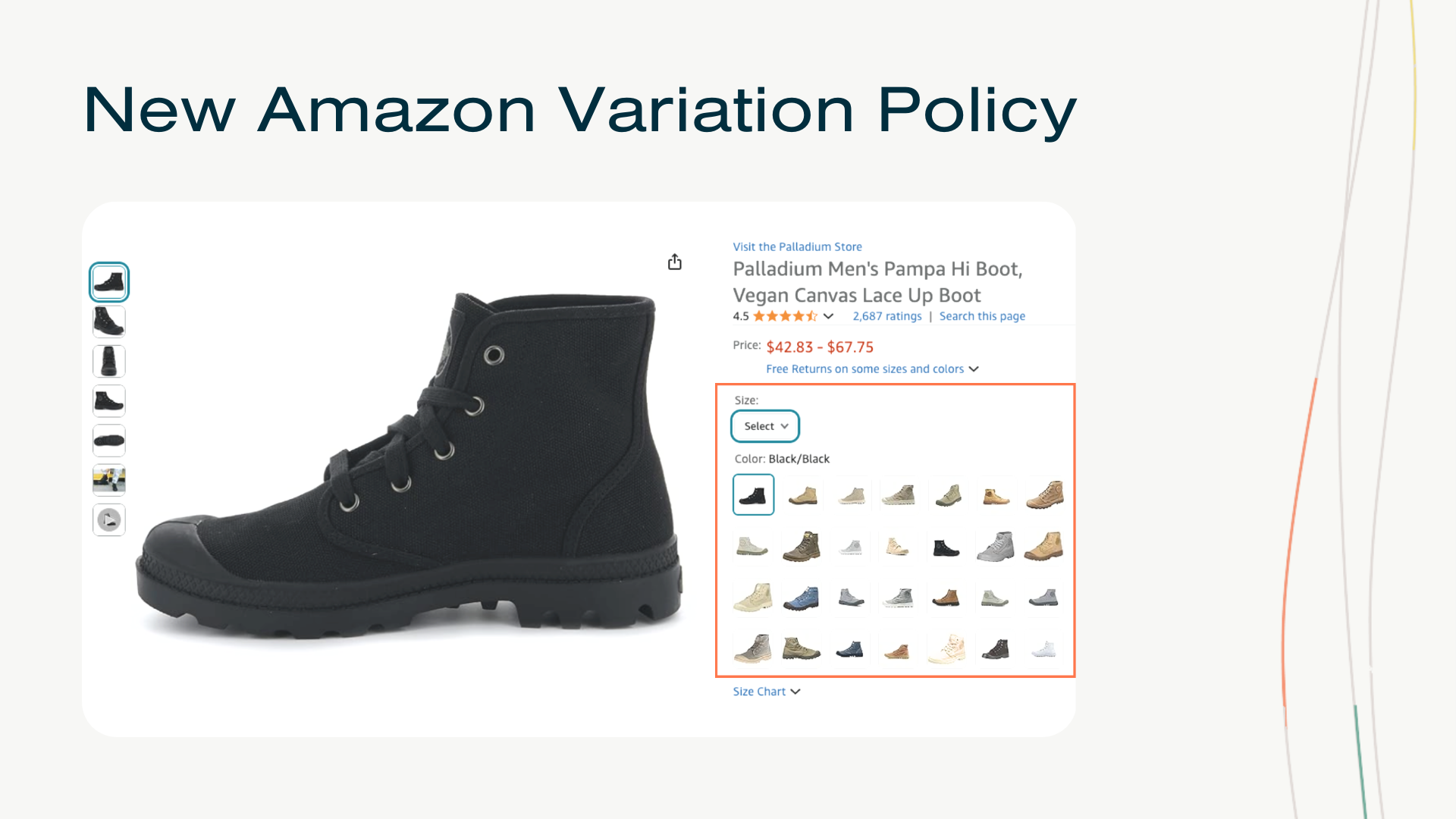

On January 7, 2026, Amazon made an announcement that significantly changes how product reviews are aggregated across variation families. Amazon has announced that moving forward, reviews will only be shared across variations with minor, non-functional differences. Products with major functional differences will have their reviews separated.
The rollout for this change is scheduled to occur in waves between February 12 – May 31, 2026, with Amazon implementing these changes gradually by product category.
Amazon has stated they will send email notifications 30 days prior to changes taking effect. However, these notifications often do not list every impacted child ASIN, making manual monitoring essential to catch all the changes that will occur.
While Amazon is making this move to improve buyer trust and reduce returns, it presents immediate challenges for brands relying on aggregate product reviews.
The “Zero Review” Risk Once Variations Separate
The most critical immediate impact is the potential for review count shifts. When reviews are separated, they are reassigned to the specific child ASIN they originated from. If you have a child ASIN that has historically relied on the parent’s rating and has very few or no direct reviews of its own, it may suddenly appear as a low or zero review product. This creates a vulnerability in search visibility, as Amazon’s algorithm heavily weighs review density when surfacing products in the search results.
Our Solution: Amazon Review Tracker for Product Variations
To monitor the change in review counts for variated products, our catalog team developed a proprietary Review Variation Tracker. Rather than waiting for an Amazon listing to tank, we pulled exact star ratings and review counts for each client ASIN prior to the rollout as a baseline to compare to as changes come through over the next few months.
We’re now tracking week-over-week changes in star ratings and review counts at the child-ASIN level for all clients with product variations set up. This granular visibility is the only way to accurately diagnose which specific variations are at risk of becoming separated and allows our team to easily and quickly spot any review issues that are taking place within the week. From there, we can productively determine how a brand’s variation strategy needs to pivot.
If you are relying solely on Amazon’s email notifications to catch review-sharing updates and determine next steps, you may already be behind. Get the same level of detail and visibility into your catalog as our clients by gaining access to our review tracker. Fill out this form and our team will get in touch with you to coordinate on next steps.
Breakdown of How Amazon Reviews for Variated Products are Changing
To understand the impact of this change, let’s look at the before vs after of how Amazon has approached review sharing for variated products.
Amazon’s Previous Policy on Review Sharing for Variated Products
For years, grouping Amazon products into variations was a dual-purpose strategy: it improved the shopping experience by organizing multiple options on a single detail page, and it allowed these products to combine reviews, giving new or lower-traffic ASINs a visibility boost via the parent listing’s social proof.
For example, brands could launch a new flavor of protein powder or a new model of a router and attach it to an existing, highly-rated parent listing. This allowed the new item to inherit the tons of 5-star reviews the legacy products had already generated – which instantly boosted its search visibility and conversion potential. This cumulative effect was arguably the biggest benefit of using variations on Amazon and a best practice when launching new products.
Amazon’s New 2026 Review Sharing Policy for Product Variations
Going forward, Amazon is drawing a hard line between aesthetic preferences and functional differences when it comes to aggregating reviews for variated products.
The new policy’s goal is to ensure that a 5-star review for one product type (eg: a chocolate protein shake) doesn’t mislead a customer purchasing a different product type available on the same listing (eg: the vanilla flavored version). In this example, the two products will taste completely different, so the consumer’s experience with the product isn’t going to be consistent from one variation to the next.
Amazon Review Sharing for Variations with Minor Product Differences
In the instance that the variation does not alter the core function of the product, reviews will remain aggregated. Amazon has explicitly confirmed review sharing will continue for product variated by:
- Color or Pattern: A blue shirt vs a red shirt
- Size & Dimensions: A 3-tier shelf vs a 5-tier shelf (provided the function is identical)
- Pack Size/Quantity: A 250ml shampoo vs a 500ml bottle
- Secondary Scent: Cleaning sprays or trash bags where scent is not the primary purchase driver
- Fitment: Phone cases for different models (eg: iPhone 14 vs. Galaxy S24)
Reviews Separated for Product Variations with Major Functional Differences
If the variation does change how the consumer uses or experiences the product, reviews will be separated. This includes:
- Flavor & Ingredients: Different tastes in food or supplements (eg: chocolate vs vanilla)
- Performance & Power: Laptops with different RAM, drills with different voltages, or appliances with different wattages
- Models & Generations: Wi-Fi 5 vs Wi-Fi 6 routers
- Material Composition: Stainless steel vs aluminum cookware, or distinct jewelry materials
- Intended User: Equipment for beginners vs advanced players
Amazon Brand Impact: What’s Already Changing?
At Brandwoven, we began monitoring this shift immediately upon the January 7 announcement. On January 12, the first wave of emails was sent to sellers and vendors, listing specific ASINs that will be impacted starting February 12.
The impact is highly variable across categories. In our initial audit of client catalogs, we saw some accounts with only 1-2 ASINs flagged, while others had hundreds of impacted products. Your catalog size and set-up (i.e. how many active variations you already have across your catalog) will determine how big of an impact this policy change will have on your account.
Real-World Examples We’ve Seen So Far:
- Outdoor & Apparel: We are seeing notifications for clients selling gear where “material” is a variation. For example, products distinguishing between “cleated” vs “boot foot” designs are being flagged for separation.
- Pet Supplies: Variations based on litter style or treat flavors are being targeted. For example, a “chicken” treat will no longer share reviews with a “salmon” treat.
- Consumer Electronics: Clients with products that are variated by specs, such as cameras with different resolutions or devices with different power outputs, are facing immediate review separation.
- Supplements & Food: This is a major area of impact. Clients with flavor variations like distinct tea blends or supplement powders are seeing their variation families break.
Actions for Brands: Adapting Your Variation Strategy
Amazon’s review policy update requires a quick pivot in how brands manage their catalogs. We are actively working with our partners to mitigate these risks, and we recommend all brands take the following steps immediately.
1. Audit Amazon Variation Themes
Review your current variation families and check that they are compliant with the new policy guidelines.
If you are using “style,” “flavor,” or “material” themes, assume these are at high risk for separation. For example, using a “color” theme for a product that actually differs by “material,” is now technically considered mis-listing. While updating the theme might not save the review sharing (since Amazon detects the functional difference), accurate catalog data is an essential best practice for preventing listing suppression – whether your products are variated or not.
2. Monitor Your Inbox, Amazon Account, & Listings
Amazon is sending email notifications 30 days prior to changes affecting specific ASINs.
- Ensure your super admin email addresses are monitored daily as this is where the emails are sent (brand managers or agency partners may not have access).
Important Distinction: The emails from Amazon simply include a list of ASINs and do not include much detail nor encompass every child ASIN on the parent listing. You will not be provided context as to why the product was flagged (eg: did Amazon view it as a flavor difference or a material difference?) or how the reviews will be split.
For example, you might receive a notification for one specific color or style, but in reality, the entire variation family is going to break. If you are only looking at the ASINs in the emails that Amazon is sending you, there is a chance that you will miss the full scope of the impact (hence why we additionally recommend tracking reviews).
3. Re-Evaluate Amazon Product Launch Strategies
The strategy of launching a new functional variation (eg: a new flavor) onto an existing high-performing parent is no longer a viable method for generating instant social proof. You must treat new functional variations as standalone launches. This also means allocating time and budget for independent awareness campaigns.
4. Leverage Amazon Vine
With parent reviews being removed for variated products that are functionally different, this implies you must invest in new review generation strategies.
One of the best ways to quickly generate reviews for ASINs with little-to-no existing reviews is by utilizing the Amazon Vine program. As long as an ASIN has less than 30 reviews, it can be enrolled into Vine. Once enrolled, your brand swaps free products in exchange for honest reviews from Amazon consumers.
5. Protect Conversion Potential with High-Quality Product Content
If a product loses its high review count, your product page content must work harder to convert traffic.
- Optimize your copy: titles and bullets that incorporate SEO keywords.
- Upgrade your imagery: carousel images, Brand Story, and A+ Content.
Focus on highlighting specific product benefits to help mitigate the trust gap left by lower review counts.
Frequently Asked Questions
Does this Amazon policy update affect both Seller Central and Vendor Central brands?
Yes. This policy applies to both 1P (Vendor) and 3P (Seller) accounts.
Will my Amazon product reviews be deleted?
No. Reviews are not being deleted, although some may be separated. The review remains associated with the specific child ASIN on which it was written. The total aggregate review count displayed on the listing page will drop to reflect only the reviews relevant to that specific variation.
How can I check if my products have data errors?
The most effective way to audit your catalog for risks is to review your backend data attributes, not just what appears on the live product page.
- Request a Category Listings Report (CLR): In Seller Central, you can request this report (sometimes you must ask Support to enable it first). It provides a comprehensive view of your backend data. Specifically, check the variation_theme column. If you see products listed under themes like “Style,” “Material,” or “Flavor” that actually only differ by “Color” or “Size,” you likely have a data error that needs correcting.
- Use the Variation Wizard: This tool in Seller Central allows you to visualize how Amazon groups your ASINs. It can help identify orphaned child items that may have broken away from the parent due to data conflicts.
- Partner with an Expert: For large catalogs, manual checks are often insufficient. At Brandwoven, we conduct catalog deep dives using our proprietary scraping tools to compare your backend data against live site content. This allows us to catch and fix any discrepancies in bulk before they negatively impact your conversion.
Which specific product categories are seeing the most review separation so far?
Based on the waves of notifications our team has received since January 12, the impact is widespread but heaviest in four key industries:
- Supplements & Grocery: Brands with flavor variations (eg: protein powders, teas, or hydration packets) are seeing almost universal separation.
- Outdoor & Equipment: Products variated by technical specifications (eg: fishing reels with different gear ratios) or materials are being flagged for separation.
- Pet Supplies: Variations for treat flavors and litter types (eg: pellet vs clumping) are being decoupled.
- Consumer Electronics: Items differentiated by power, resolution, or generation are seeing immediate impact.
Can I appeal Amazon’s decision to separate my product reviews?
You cannot appeal the policy itself; Amazon will not grant an exception for products that are functionally different (eg: different flavors or wattages). However, you can resolve a separation if it was caused by incorrect catalog data.
If your products are eligible for sharing (eg: they only differ by Color) but were separated because they were initially variated through another theme like “Style,” you should take the following steps:
- Verify the Data: Ensure the products truly differ only by non-functional attributes.
- Update the Theme: Change the variation theme in Seller/Vendor Central to accurately reflect the difference (eg: change Style to Color).
- Submit a Case: Open a support case stating you have updated the data to reflect that the items are functionally identical.
Our team assists with catalog analysis and case work when direct follow-up to Amazon is necessary.
How will this policy update affect my Amazon Vine enrollment strategy?
This policy shift makes Amazon Vine more critical than ever. Previously, you could launch a new variation and rely on the parent listing’s existing reviews for social proof. Now that functional variations (like new flavors or models) will launch with zero reviews, you cannot rely on that halo effect. You will need to treat these functional variations as standalone launches. We recommend enrolling these specific child ASINs into Amazon Vine immediately upon launch to generate those first 30 reviews, ensuring the product has its own independent social proof.
Conclusion
Amazon’s move to separate reviews for functionally different product variations signals a continued focus on data accuracy and customer trust. While this update complicates the product launch and customer review strategies many brands have used for years, it also creates a playing field where product quality and specific customer feedback shine.
At Brandwoven, our Catalog Managers and Client Success teams are already deep into auditing client accounts and adjusting strategies to ensure our partners are not caught off guard. We are tracking review counts weekly against baselines and flagging high-risk ASINs before changes go live.
If you are unsure how your catalog will be affected by this policy update, or if you need a strategy to protect your conversion rates as these changes roll out, do not wait until May. Connect with our team for assistance!