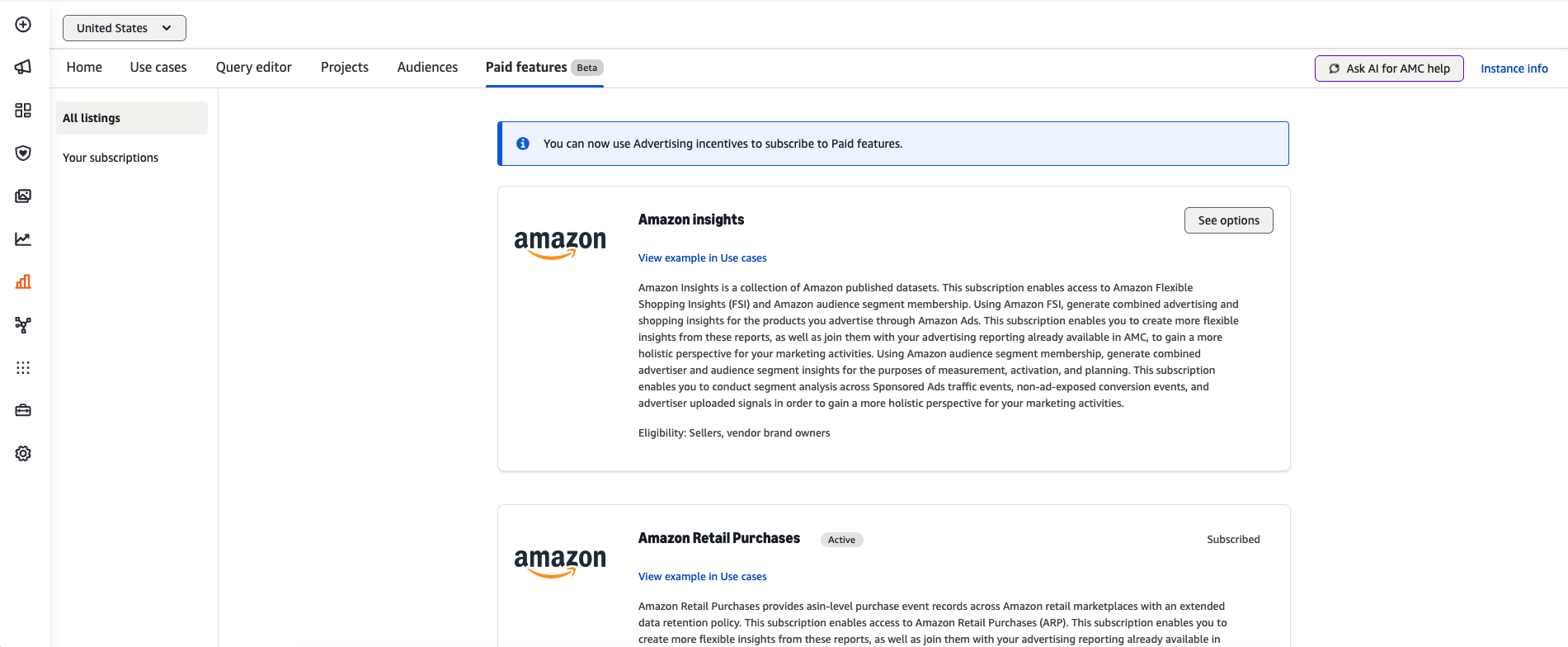
Amazon has temporarily removed the paywall on its first-party Amazon Marketing Cloud (AMC) Paid Features datasets. This massive data expansion is a game-changer for advertisers, giving brands access to premium AMC datasets at no additional cost through December 31, 2026.
This update provides the tools to answer more sophisticated questions around shopping behavior. If you are looking to elevate your brand’s performance on Amazon, now is the perfect time to lean in and leverage these newly available signals to maximize ad ROI.
What is Included in the AMC Data Expansion?
The expanded AMC access removes the paywall for several powerful first-party datasets. Brands can now access the following at no additional cost:
- Amazon Shopping Insights (ASI)
- Flexible Shopping Insights (FSI)
- Retail Purchases (up to 5 years of purchase history)
- Brand Store Insights
- Prime Video Insights
- Amazon Your Garage
Note: While these first-party Amazon datasets are now free, third-party datasets (such as Experian) still require paid subscriptions.
How the Data Expansion Compares to Standard AMC Reporting
For years now, AMC has been excellent at measuring advertising performance. However, standard AMC reporting represents only half of the customer journey. These standard reports only track ad-attributed shoppers, rely on ad impressions and clicks, and are limited to a 13-month lookback window.
The new Paid Features access provides visibility into the full customer journey, including:
- Last 5 years of data
- Organic purchases, traffic, and engagement
- Audience creation beyond ad-engaged shoppers
- Long-term customer behavior
- Customer lifetime value (LTV)
- Subscription adoption
- Repeat purchase trends
- Product migration paths
- Incrementality measurement
Traditional AMC analysis primarily answered, “what happened because of our advertising?” whereas the ASI and FSI datasets expand beyond advertising into true customer intelligence, helping to answer, “what happened regardless of advertising?”
Standard AMC vs. ASI/FSI: Lengthened Data Window & Organic Analysis
Standard AMC provides a 13-month lookback, whereas ASI and FSI unlock up to a 5-year purchase history. Standard AMC also tracks ad-attributed shoppers while Paid Features track all shoppers, allowing brands to view both organic and paid behavior.
This lengthened lookback window combined with the ability to review all traffic behavior (not just that from your ad investment) is a hugely helpful update. Brands can now look at audience creation beyond ad shoppers to analyze organic purchases, organic traffic, and engagement (from the last FIVE years)!
Summary of Key Differences:
| Standard AMC | ASI / FSI |
|---|---|
| Ad-attributed shoppers | All shoppers |
| Ad impressions & clicks | Organic + Paid behavior |
| 13-month lookback | Up to 5-year purchase history |
| Campaign performance | Full customer journey |
| Retargeting audiences | Net-new audience opportunities |
| Attribution analysis | LTV and retention analysis |
High-Value Audience Opportunities: 5 Strategic AMC Use Cases
The biggest opportunities with this data expansion are answering strategic questions around who your customers really are, what they do after their first purchase, how much they are worth over time, and which shoppers you should stop targeting vs prioritizing acquiring.
Here are some of the most impactful scenarios your brand can run using this expanded data:
1. Targeting Organic Purchasers Who Have Never Seen Your Ads
Brands can now identify customers who purchased products organically without ever receiving an ad impression.
New AMC Use Cases:
- Exclude these shoppers from Amazon DSP prospecting campaigns to reduce wasted media spend on customers who are already buying organically.
- Create lookalike audiences based on these high-value organic purchasers to measure true incremental reach.
Key Question to Answer: How much media spend is reaching customers you would have acquired anyway?
2. Customer Lifetime Value (LTV) Analysis
This is arguably the biggest opportunity provided by the expanded data. Instead of evaluating customers solely on their first purchase revenue, brands can now evaluate their worth across a full 5-year span. This valuable insight can dramatically improve your acquisition targets and budget allocation decisions.
New AMC Use Cases:
- Map out repeat purchases
- Look at organic purchases, ad-driven ones, and compare the two
- Evaluate Subscribe & Save revenue
- Understand your multi-year customer retention
Key Questions to Answer:
- What is a customer worth over 2 years? Over 5 years?
- How much can you afford to spend on acquiring a new customer?
- Which acquisition channels drive the highest long-term value?
For a deeper dive into how AMC enables advanced attribution and LTV analysis via SQL querying, download our comprehensive Guide to Leveraging Amazon Marketing Cloud.
3. Re-Engaging Organic Buyers from Prime Day
Prime Day generates substantial organic traffic and purchases, but historically many of these customers disappeared after the event because they were invisible to standard AMC reporting.
New AMC Use Cases:
- Track these buyers to re-engage them 2-4 weeks post-event
- Promote complementary products
- Push Subscribe & Save enrollment
- Launch replenishment campaigns
Key Question to Answer: How many first-time customers acquired during Prime Day can you convert into repeat purchasers?
For a look into how we utilize AMC in the lead up to tentpole events, see our related article: 4 Amazon Marketing Cloud Reports for Prime Day.
4. Uncovering Subscribe & Save Opportunities
Expanding on the above scenarios, this AMC data expansion makes it much easier for brands to identify customers who have repeatedly purchased without ever enrolling in Subscribe & Save.
New AMC Use Cases:
- Launch highly targeted DSP campaigns promoting Subscribe & Save
- Know when to send retention-focused messaging
- Offer custom bundles specifically to shoppers who are already demonstrating subscription-like behavior
Key Question to Answer: Which customers are demonstrating subscription behavior without actually subscribing?
5. Reaching Lapsed Customer Audiences
Because Retail Purchases now provides up to 5 years of historical purchase data, brands can now easily identify customers who are due for retargeting.
New AMC Use Cases:
- Identify customers who purchased 12, 18, or 24+ months ago
- Run seasonal reactivation efforts
- Launch win-back campaigns
- Retention measurement
Key Question to Answer: How many former customers have simply fallen out of the buying cycle?
Additional AMC Data Insights Worth Exploring
Beyond the core audience scenarios above, the expanded datasets allow for advanced operational and analytical insights, including:
- Product Migration Analysis: Understand how customers move through your catalog. Do shoppers start with a trial size and graduate to larger packs? Do they move from single units to multipacks? Which ASINs create the highest repeat purchase behavior?
- Subscribe & Save Journey Analysis: Brands can now answer how many purchases occur before enrollment, what products generate the highest subscription adoption, and the average time to a Subscribe & Save conversion.
- Attribution Window Validation: Many brands optimize around a standard 14-day attribution window. AMC Paid Features help answer how long after seeing an ad customers actually purchase and if these conversions are occurring outside of the standard reporting window. If so, you may be undervaluing upper-funnel tactics that are worth investing in.
- Category Halo Analysis: Measure impact beyond an advertised ASIN. For example, if an ad promotes Product A but the customer ultimately purchases Product B or something else within the brand portfolio, AMC will be able to tell you. This visibility gives brands a more complete view of their ad campaigns’ impact on sales – even when purchases are not directly tied to a given ad. With this perspective in mind, brands can evaluate metrics like ad sales and ROAS more effectively, understanding that even when direct sales aren’t generated from a given campaign, perhaps a significant amount of unattributed sales were.
Recommended Amazon Marketing Cloud Testing Plan
To prevent your brand from getting overwhelmed by the sheer volume of new data this update made available, we recommend structuring your AMC analysis into three tiers:
- Tier 1: Start by identifying organic purchasers who never saw ads, Subscribe & Save candidates, post-Prime Day first-time organic buyers, and lapsed customer audiences.
- Tier 2: Move on to Customer LTV modeling, product migration analysis, subscription path analysis, and attribution window analysis.
- Tier 3: Finally, tackle category halo measurement, incrementality analysis, organic vs paid customer comparisons, and net-new customer acquisition efficiency.
Important Note When Gaining Access to AMC’s Paid Features
These new AMC historical signals are available to Amazon brands right now, but you need to proactively opt in to receive access to the additional data.
Before You Get Started: It’s important to note that these features are only free through December 31, meaning that if you opt into these features and do not opt out before the end-of-year deadline, you will be charged a fee to continue access into 2027. To utilize the benefits of this offer without future risk, we strongly recommend tracking when/if you opt in and setting reminders towards the end of the year to decide whether to continue with paid access or be removed from the feature before 2027.
Leverage Our Amazon Marketing Cloud Capabilities
Brands that take advantage of AMC’s newly available datasets should be able to build more efficient DSP audiences, improve retention efforts, and make significantly better customer acquisition decisions. And we know that effectively navigating this powerful tool is where having the right partner makes all the difference.
Brandwoven specializes in helping brands achieve marketplace success through data-driven strategies. With a marketing team used to managing over $1.2 million in average monthly ad spend, we know how to handle the heavy lifting of data reporting and analysis that Amazon Marketing Cloud offers.
If AMC data is overwhelming to your team or you simply need more efficient marketing campaigns, we’d be happy to help. Reach out and we can talk through exactly where your brand is missing out on these opportunities for growth.