Article
Walmart Review Accelerator Programs: Comparison & Real Results
On ecommerce marketplaces like Amazon and Walmart, customer reviews are extremely important. A plethora of strong reviews can increase visibility and sales while a lack of reviews, or lots of negative ones, will make it significantly harder for new customers to trust your product.
Amazon offers its Vine program to help sellers boost reviews, and Walmart recently revamped its Review Accelerator program to align with other marketplaces. Now, rather than a single program offering, Review Accelerator provides two solutions:
- Post-Purchase Reviews
- Recognized Reviewer
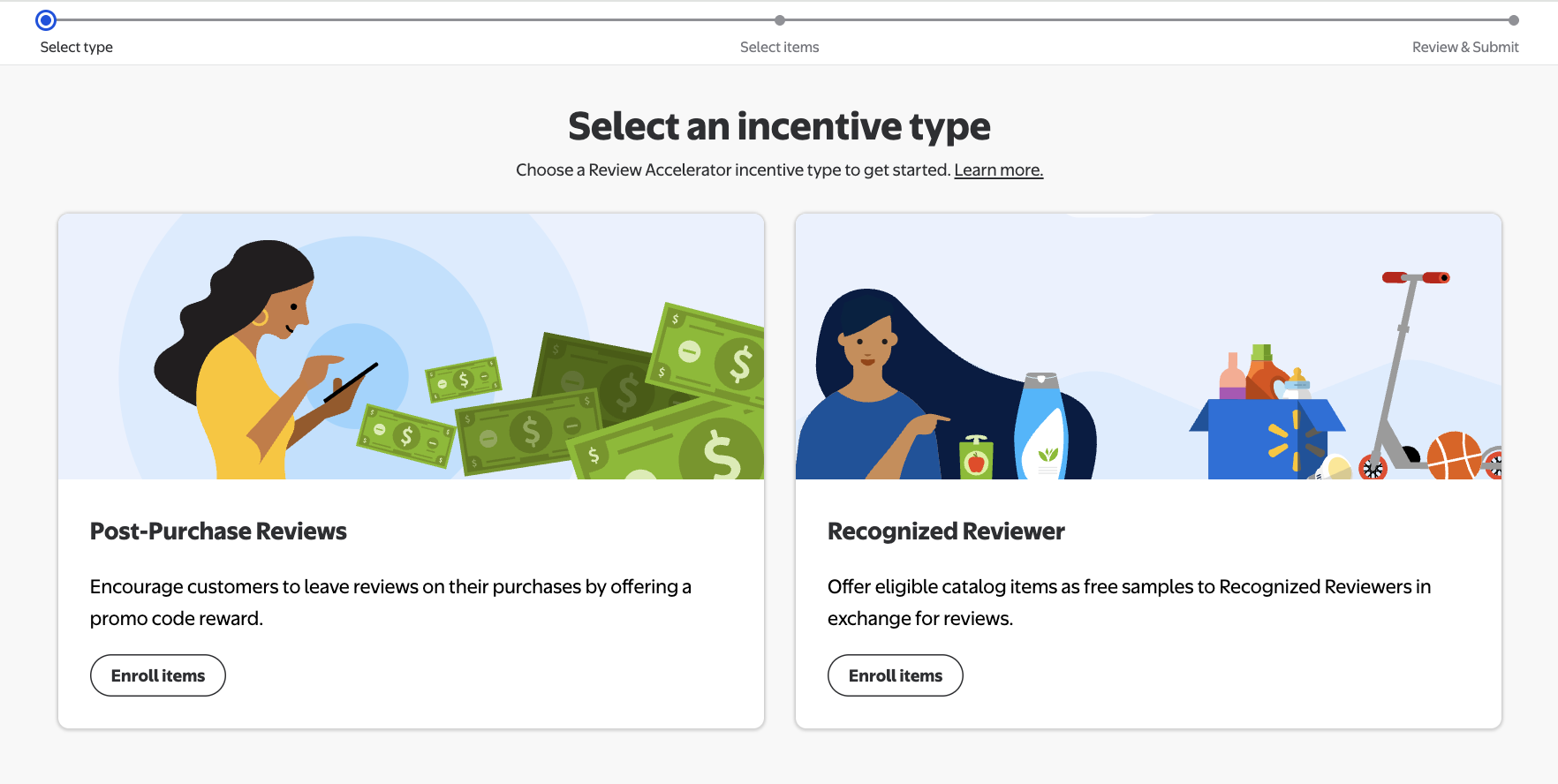
Both of these programs live on the Review Accelerator page under the Growth section of Walmart Seller Center. There, sellers can check item eligibility, enroll items, and monitor results.
Note that meeting the published eligibility criteria does not guarantee inclusion; Walmart reserves the right to determine item and seller eligibility at its sole discretion.
Both programs offer the same goal to increase review count, but the way in which the reviews are gathered is very different. Additionally, the two programs solve different problems:
- Based on the product requirements for enrollment, one can be used for items that are already selling but not accumulating reviews.
- The other program is more helpful for items with almost no review history that need social proof before they can compete.
Also note that product eligibility is updated on a weekly basis, so it is helpful to check back regularly for new enrollment options.
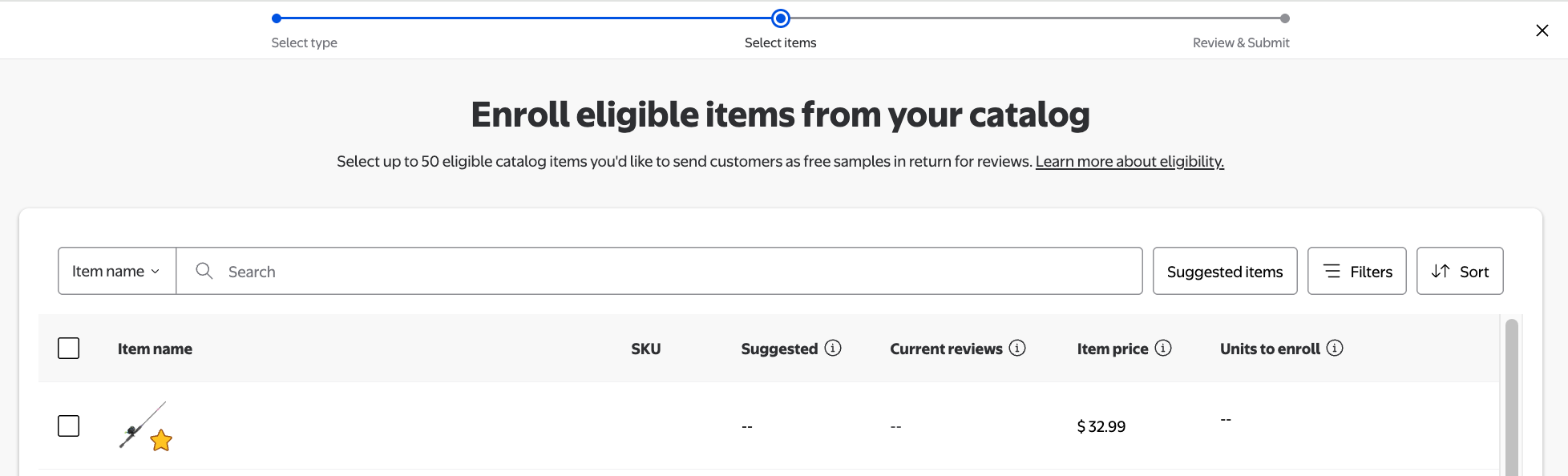
How Does the Post-Purchase Reviews Program Work?
Post-Purchase Reviews was Walmart’s original review gathering program. It still exists and is available within the Growth Dashboard of Seller Center.
The program works by sending customers a coupon via email that can be used towards a future purchase in return for a review. After the customer purchases the product, they receive an email explaining the incentive program and the opportunity to leave a review in exchange for the coupon.
To be eligible, an item must have prior sales history and fewer than 15 reviews. The eligible item list refreshes by Wednesday each week, sorted with the items Walmart believes have the greatest chance of conversion at the top. Only one seller can enroll a given product at one time, so if an item you expected is missing from your list, another seller may have already claimed it.
During enrollment, you can select items individually or upload in bulk via spreadsheet. You must set a target review count and incentive amount per item. The minimum incentive is $5 per review, and the maximum is the lesser of 25% of the item’s price or $25.
Be aware that variants share reviews, so enrolling a base item in Post-Purchase Reviews enrolls the entire variant group. Additionally, reviews on any variant count toward the collective total.
Once an item hits its target number of incentivized reviews, it is automatically unenrolled, though customers can still submit reviews up to 48 hours after unenrollment. You are only charged for reviews that pass moderation and post to Walmart.com, up to your target.
The dashboard offers a downloadable report of charges, pending charges, settlement dates, and credits. Enrollment can also be managed through Walmart’s Post-Purchase Reviews APIs after accepting the terms in Seller Center.
Although the Post-Purchase Reviews Program is a call-to-action which provides compensation in return for reviews, it comes with several challenges and, in general, is not very enticing to the customer.
Challenges to the Post-Purchase Reviews Program
- The customer must have intent to purchase the product on their own.
- The customer has to pay for the product.
- The customer must open the incentive email after their first purchase and be interested in a second purchase that would then allow them to use the incentive coupon provided.
- The seller has to cover the incentive amount in addition to the fee collected by Walmart.
- Items that already have 15 or more reviews are excluded.
- Items that complete their review target cannot be re-enrolled.
Program Benefits
Despite the challenges listed above, one particular perk to the Post-Purchase Reviews program is that it is available to all consumers on Walmart’s marketplace—so regardless of who buys the product, they are eligible to receive this incentive.
This program also works well for established listings, since the prior sales history requirement means you are layering reviews onto demand that already exists.
How Does Wamart’s New Recognized Reviewer Program Work?
Recognized Reviewer operates similarly to other ecommerce incentives: a shopper can enroll to receive access to products they may receive for free in exchange for a review. This setup eliminates several challenges the Post-Purchase Reviews program came with.
Eligibility for Recognized Reviewer is more strict: items must have fewer than 10 reviews, positioning the program as a new item launch tool.
Enrollment follows the same path through Seller Center, but instead of setting a dollar incentive, you commit units. You must enroll at least five units and can enroll up to 30 units per item group, with no limit on how many items can be enrolled at a given time.
- Variants can be enrolled individually by adding units at the variant level.
- First-time enrollment requires accepting the program terms and conditions, which are then saved to your Seller Center agreements.
After you submit, the Recognized Reviewer dashboard tracks units enrolled, claimed, and reviewed for each item. Once every unit is claimed, an item’s status changes to Completed. Unlike Post-Purchase Reviews, you may be able to re-enroll a product if it still meets eligibility and has not hit the maximum review threshold.
Benefits to Walmart’s New Recognized Reviewer Program
- The shopper sees your product in the list of available options for them. This allows sellers to reach customers that may not have otherwise discovered their products.
- The customer receives the product for free in exchange for a review.
- The customer is aware of the process and has undergone vetting from Walmart, increasing the chances that they will follow up with the review.
- Sellers are only charged for reviews that are actually published, not for every unit claimed.
- Items can potentially be re-enrolled after completion, as long as they remain eligible.
Program Challenges to Be Aware Of
- Since the customer is not specifically looking for your product, they may be unfamiliar with your product category and how your item compares to that of competitors.
- Sellers are responsible for the full cost of the samples, the associated shipping expenses, and any applicable program fees (the cost per review is displayed during enrollment).
- The five-unit minimum means every enrollment carries real inventory cost, which adds up across a wide catalog.
How Do Verified Reviews Display on an Item Page?
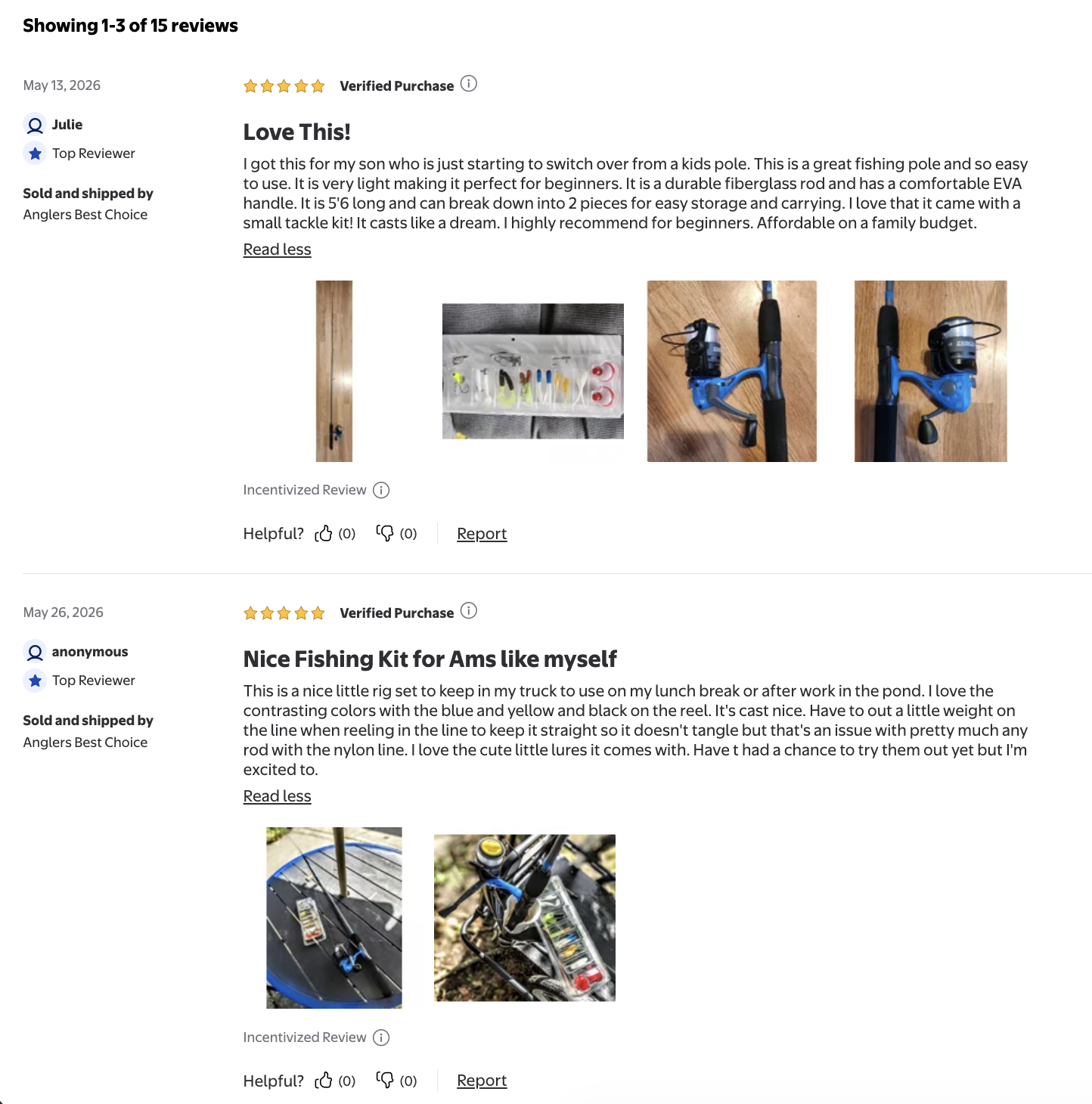
Reviews from both programs are labeled with an incentivized badge and displayed alongside organic reviews on the item page. Walmart also confirms that incentivized reviews come from verified purchasers.
Note that incentivized reviews can appear on your listing even if you never enrolled your product; reviews attach to an item rather than to a seller or offer.
Real Results from Testing Both Walmart Review Accelerator Programs
After testing the Post-Purchase Review program and not generating as many reviews as expected, our team was excited to learn about Walmart’s new Recognized Reviewer program. Here is a comparison of our results:
| Program Details | Post-Purchase Review | Recognized Reviewer |
|---|---|---|
| Number of items enrolled | 8 | 9 |
| Fee per review written | $15 ($5 incentive + $10 fee per review collected) | Cost of the product (no additional fees) |
| Total number of reviews received | 39 | 132 |
Note: Fees are subject to change and are specific to the seller profile. Consult with our team for specific fees regarding each program.
Which Walmart Review Incentive Program Makes Sense for You?
Based on our clients’ specific needs, we found the Recognized Reviewer program to deliver a much better return on investment, however if your product has a long sales history and you are still looking to boost review count, the Post-Purchase Review program is an additional lever you can pull. Depending on your product catalog and goals, you can also use both programs concurrently.
Sellers should also consider Review Syndication, which publishes reviews collected on your D2C website to the matching item on Walmart marketplace.
If you aren’t sure which program makes sense for your brand, need help managing them, or don’t know which incentive amount is best given your margin, our team would love to help. Not only do we have hands-on experience with both review accelerators, but we also offer a full suite of Walmart marketplace management services to assist with everything from setup, optimization, testing, and long-term growth strategies. If you’re interested in learning what a partnership with our team looks like, reach out through the link below.