Article
Advertising Strategies for Amazon Prime Big Deal Days 2026
Amazon’s 2026 fall tentpole event, Prime Big Deal Days (PBDD), is fast approaching. Amazon recently confirmed the exact dates as October 6-7, 2026. To help both our current clients and prospective partners navigate the high-stakes sales event, we’re sharing a look into our planning process, advertising strategies, and event management tips. Built on fresh learnings from Prime Day 2026, let’s walk through the Amazon PBDD timeline, how to calculate your margins, our recommended bidding rules, and audience targeting strategies.
Factoring in Contribution Margin: Why ROAS Isn’t Enough
Relying on ROAS alone is a trap. PBDD discounts can significantly compress product margins before advertising spend is even factored in. A product generating a 5x ROAS at a 15% margin can be less profitable than one with a 3.5x ROAS at a 40% margin.
Before Amazon PBDD, calculate your contribution margin percentage by Hero ASIN or category (post-discount, pre-ad-spend) using this formula:
Break-Even ROAS = 1 / Contribution Margin % (before ad spend)
Flag any deal ASINs with margins thin enough that an aggressive ad push could cause them to run at a loss. During the event, push higher-margin Hero ASINs and keep bids flat on thin-margin deal ASINs, even if their ROAS looks strong on the surface.
Prime Big Deal Days 2026 Timeline
We are already in the planning stages for PBDD with our brand partners. Here is the timeline we’re using to set our brands up for success:
Planning & Alignment: August to Late September
Focus on strategy development, deal confirmations, and forecasting. During this phase, lock in your hero ASINs, verify inventory, and gather contribution margin data.
Lead-In Period: Early October
Start implementing budget increases, ranking strategies, and building high intent audiences with Amazon Marketing Cloud (AMC).
Launch Sponsored Brands Video (SBV) and Sponsored Display (SD) ahead of PBDD to build awareness and engagement. Then re-engage high-intent shoppers during and after the event through Sponsored Display and AMC audiences.
Around October 3-5, consider pushing bids up by ~10% across priority campaigns with strong CVR rates and healthy contribution margins to establish momentum. Depending on how aggressive you want to be, ramp bids to approximately +15-20% if you’re planning on heavier participation, especially with HERO products and Defensive campaigns.
Prime Big Deal Days Event: October 6-7
During the event window, emphasize manual optimization (as needed), pacing management, and defense-first execution to protect your brand’s share of voice. To navigate the event’s hectic pace, we recommend you plan for the following:
- Physically check Amazon detail pages on the first morning of PBDD to confirm that deal badges are actively displaying. Driving paid traffic to a discounted ASIN without a live deal badge burns ad spend and wastes conversion potential.
- Do not just check in at the end of the event to see how you did; monitor performance throughout to adjust as needed. For example, our marketing team at Brandwoven follows a 4x/day monitoring cadence in the early morning, mid-day, late afternoon, and evening. We look at budget pacing, CVR trends, and inventory levels to make sure our brands stay on track to hit their goals, or can adjust campaigns mid-event if needed.
- In the instance that your brand faces mid-event stockouts, listing suppression, or any other issues preventing shoppers from finding or buying your products, immediately shift their promotional dollars to other ASINs.
Lead-Out Period: Mid-October
Trail bids back down by 10% to normalize spend efficiency and prepare for the transition into Black Friday and Cyber Monday.
The Escalating Cost of Amazon Tentpole Events & What to Expect This PBDD
To succeed in October 2026, we must look at what happened during October 2025 and June 2026:
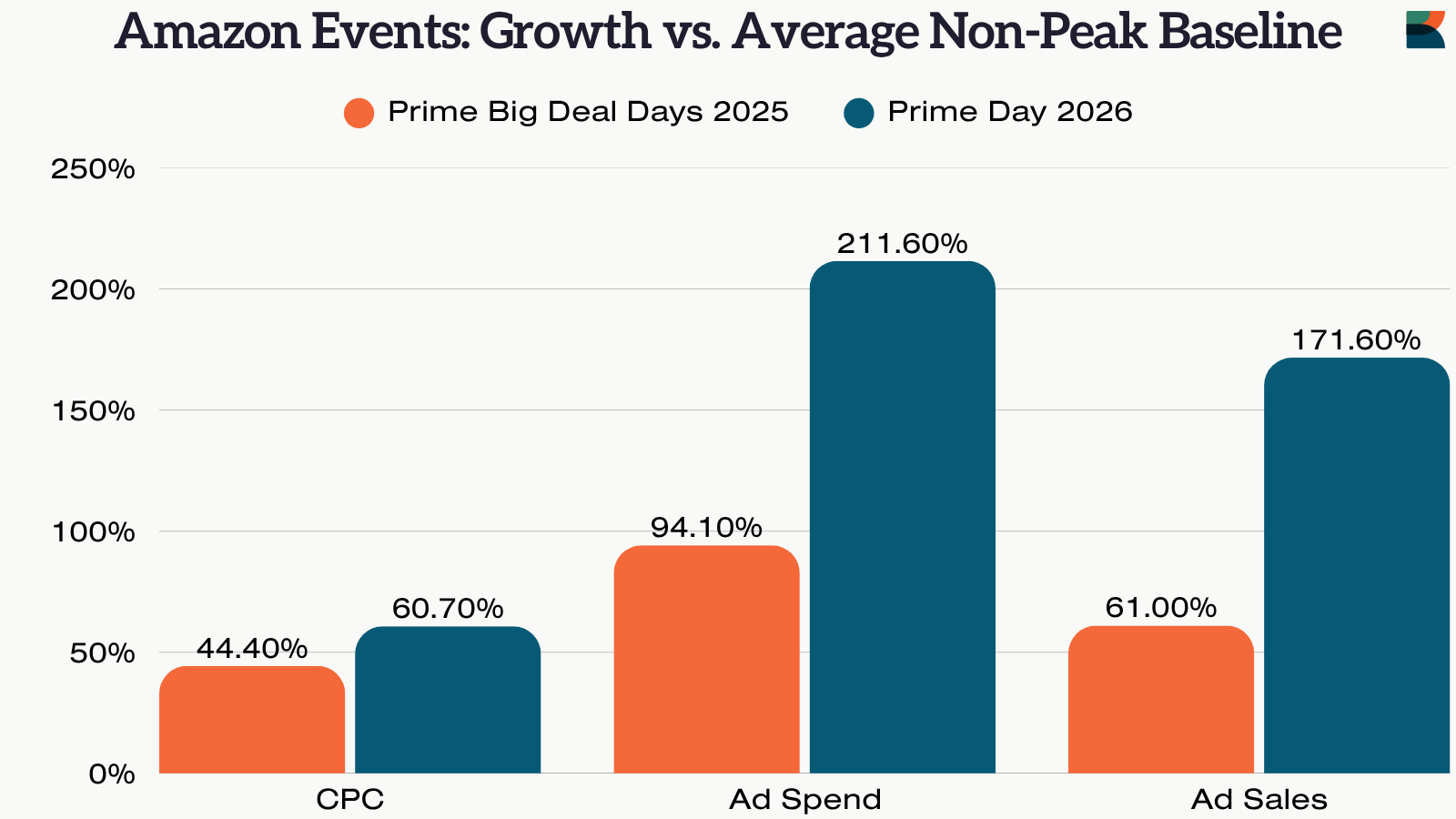
- October 2025 (Prime Big Deal Days): Compared to the prior 3-week non-peak baseline, CPCs surged by +44.4%, ad spend jumped +94.1%, and ad sales rose +61.0%. This showed just how competitive—and expensive—this Q4 kickoff event was for brands entering the holiday season.
- June 2026 (Prime Day): The platform saw even greater auction volatility. Compared to the non-peak baseline, ad spend exploded by +211.6% and ad sales grew by +171.6%, while CPCs inflated by +60.7%. Because spend growth outpaced sales growth while CPA climbed and conversion rates softened, ROAS compressed. These fluctuations proved that traffic quality mattered more than traffic volume.
What does this mean for PBDD 2026?
A 2-day event leaves no room for performance drift. There is a real risk of CPCs skyrocketing again, so brands must prepare by pairing aggressive budgets with highly efficient bidding strategies to stay in budget while beating competitors for top category terms.
Four Strategic Ad Strategies for Amazon PBDD 2026
Every tentpole event forces brands to balance aggressive product-level sales growth with category share and margin compression. We’ve seen time and time again that brands who expect a significant lift must invest in marketing, but the type of campaigns they run and why is the most important question to make before any other decisions are made. To exit the event feeling satisfied in your investment, choose from the strategies below based on what aligns best with your brand’s current priorities and marketplace growth goals.
1. Boost an Individual Product
Use PBDD to accelerate an ASIN that already shows signs of product-market fit but needs additional sales velocity, ranking, or review momentum. This can include newer products, but brands should be cautious about putting significant event budget behind completely unproven ASINs, particularly when CPCs are elevated.
Target Metrics:
- Item BSR
- Subcategory Rank
- Orders
- CTR
- CVR
2. Market Share Growth
Increase your brand visibility inside relevant categories by discounting your top-performing products to win share on category keywords. This strategy is mainly an investment in customer acquisition and long-term ranking rather than immediate profit. It works best if your brand sells in a highly contested category where share is winnable and is likely the best strategy if your brand leadership is prioritizing share of voice growth over near-term margin.
What to expect with this strategy:
- Aggressively win conversion share on top generic and category keywords by driving a massive volume of sales during the event window. You may drastically improve a product’s Best Seller Rank (BSR) and organic keyword ranking.
- The heavy push may drive your account to low profit during the event. You will be paying inflated CPCs to acquire clicks on a product that is temporarily selling at a steep discount, so we only recommended this strategy with hero ASINs.
- Your margins will compress heavily as ad spend eats up your discounted revenue. After PBDD, as prices return to normal, your hero products will have earned higher organic rankings and captured a much larger share of sales. This will set your brand up for easier shopper discoverability during the rest of Q4.
Target Metrics:
- Keyword CVR
- Total SOV
- Organic SOV
- Item Revenue / POs
3. Upsell Loyal Customers
Discount high-priced, high-margin products to upsell loyal shoppers who are already searching your branded keywords. This is ideal when your ultimate goal is profit and AOV rather than new-customer acquisition. To find success, ensure your branded search volume is strong enough to carry the push alone.
Target Metrics:
- ROAS
- AOV
- LSV
4. Combination of the Above
Most mature accounts segment their budget across all three plays by ASIN tier. For example, boost your underperforming ASINs to build proof of demand, push for category SOV growth on established hero ASINs, and upsell brand-loyal traffic on premium or high-margin products simultaneously.
If running multiple strategies, make sure to watch for overlapping discount depth to avoid cannibalizing margin.
Bidding & Pacing Controls
During the event, implement these rules for maximum efficiency:
- If you are using a bid management tool, consider turning off Auto-Pacing to rely on manual, real-time control.
- While standard pacers should be off, refill triggers for priority Hero campaigns are still highly recommended to capture midday demand. When set, this rule will automatically increase your daily budget if one of your campaigns hits its target daily ROAS.
- Start event-day increases around +10-15% for Hero and Defense campaigns to hold rank through peak traffic. Only scale toward +25% where ROAS, CVR, and contribution margin support the extra cost.
- Tail bids back down –10% through the lead-out window to normalize spend efficiency.
High-Value AMC Audiences to Target
Use AMC audiences to prioritize high-intent shoppers across Amazon DSP and Sponsored Display, while applying AMC audience bid boosts to Sponsored Products and Sponsored Brands.
High-priority audiences to target are:
- Added to cart but did not purchase – The highest-intent audience. The event discount gives you a strong reason to bring them back.
- Multiple detail page views – Valuable for Hero ASINs where shoppers may have been waiting for a price drop.
- Clicked Sponsored Ads but did not purchase – Capture shoppers you’ve already paid to acquire.
Audiences to Deprioritize
Historical high spend doesn’t mean a customer is currently in-market. To avoid wasting budget on cold audiences that lack immediate purchase intent, deprioritize general high-value customer segments.
FAQs About Amazon PBDD Advertising Strategies
When should brands ramp up bids for Prime Big Deal Days 2026?
Around October 3-5, consider pushing bids up by ~10% across priority campaigns with strong CVR rates and healthy contribution margins to establish momentum.
How frequently should brands monitor campaigns during Prime Big Deal Days?
We recommend four check-ins per day to track spend, inventory levels, event badging, and CVR trends.
What should brands do immediately after Prime Big Deal Days?
Trail your bids back down by 10% to normalize spend efficiency. Analyze sales and profitability and carry those learnings into your Black Friday and Cyber Monday ad planning.
Navigating Tentpole Events with Brandwoven
Tentpole events represent massive opportunities for brands, but they also bring significant margin risks and fierce competition. Succeeding during Amazon Prime Big Deal Days 2026 will require more than just aggressive bidding, with a fully coordinated strategy across your inventory, pricing, and advertising.
At Brandwoven, we specialize in helping brands navigate these high-stakes events with data-driven strategies and capabilities spanning logistics, performance marketing, and catalog management. In partnership with us, gain access to the impactful combination of AMC audience targeting, margin-adjusted bidding, and real-time event monitoring to ensure success.