Article
Amazon Study: Low Inventory Levels Impact Your Featured Offer
It is a widely accepted truth in Amazon logistics that staying in stock is critical for success. However, the exact threshold where low inventory begins to negatively impact your Featured Offer (Buy Box) and Prime delivery speeds has largely been based on intuition and “best practices” rather than concrete data.
At Brandwoven, our logistics and demand planning team set out to map this correlation and find the definitive line where inventory breaks buy box integrity. What we discovered definitively changes how we approach inventory forecasting for our Amazon brand partners going forward.
Overview of Findings
We initiated this study to solve a practical dilemma brands often face during shipment planning: demand forecasts naturally vary across their catalog. A brand might plan to send thousands of units for their flagship products but only forecast small quantities for niche products, brand new products, or experimental items.
Our study produced definitive evidence that even for low-velocity items, having 25 units on hand as a minimum baseline is required for buy box integrity. We learned that Amazon penalizes low stock long before taking away the buy box entirely, and in some cases, sending less units to Amazon simply won’t be enough to earn the buy box at all.
For the vast majority of consumer brands utilizing Amazon FBA, use this 25-unit threshold as a critical baseline. Doing so gives Amazon’s network the minimum depth it needs to guarantee fast, nationwide coverage without degrading purchase messaging or product visibility.
Behind the Scenes of Our National Field Study
To gather actionable, localized data, we conducted a national field study analyzing 336 FBA ASINs across 20 distinct ZIP codes, resulting in 6,720 individual product detail page (PDP) checks. We categorized every FBA ASIN by its fulfillable quantity in intervals of 25 (from 1 up to 200+). We then drew random samples capped at 50 ASINs per bucket to maintain clean data sets and relative weighting.
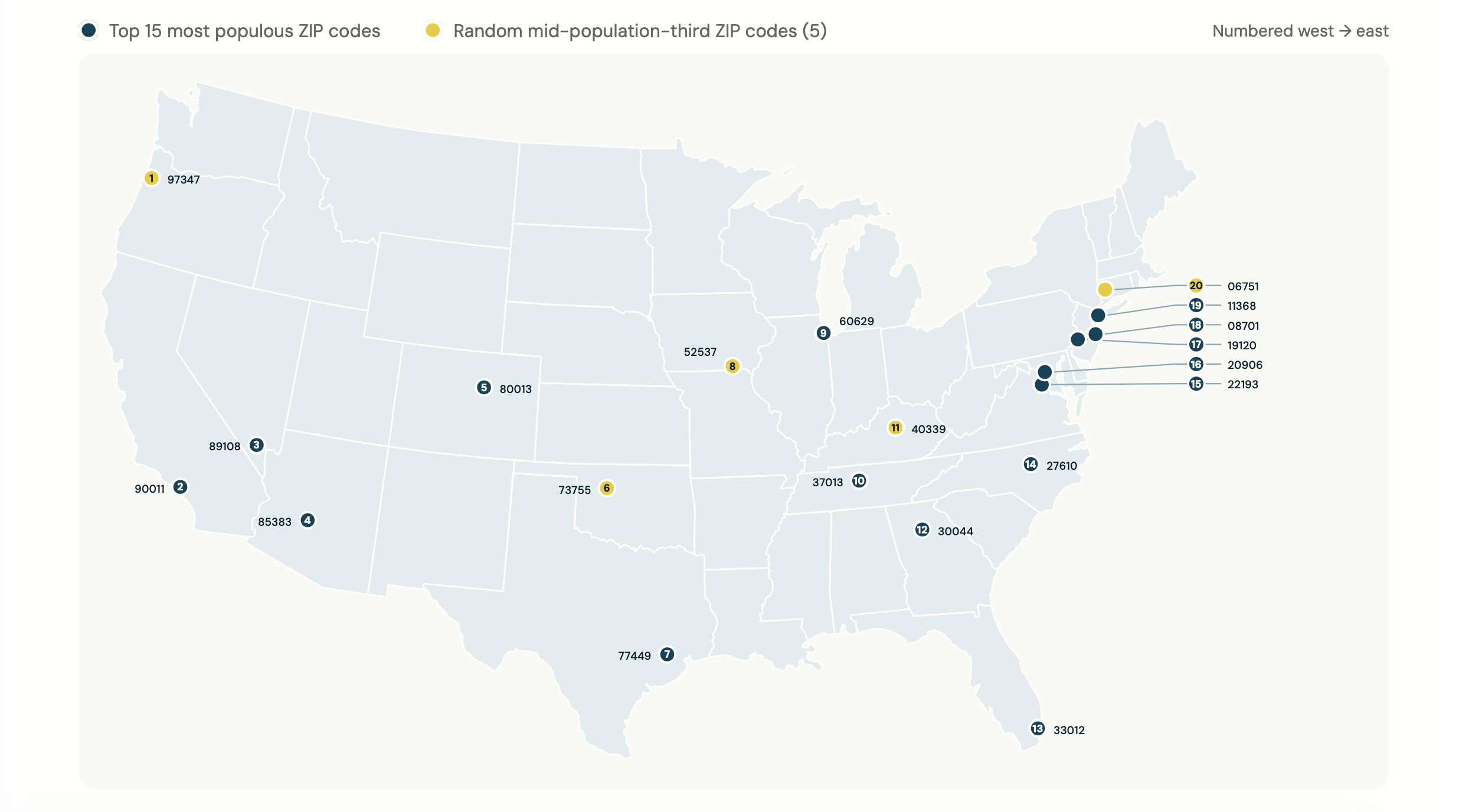
We then checked PDPs across the 15 most populous U.S. ZIP codes, alongside 5 random mid-population ZIP codes (capped at one per state). This ensured we accounted for regions with heavy infrastructure as well as areas without nearby fulfillment centers. Using a rotating proxy service, we executed these location-specific checks to see exactly what shoppers in those specific regions were seeing for buy box messaging, in real-time.
Disclaimer: Factoring in Inventory Velocity
It is important to remember that this data represents a snapshot in time. A product showing 15 fulfillable units today might have another 50 units sitting in a receiving status, or it might sell out completely by tomorrow. Because Amazon inventory is so fluid, demand planning cannot rely on static numbers. We always recommend brands build buffer stock and closely monitor restock lead times to ensure sellable inventory never dips too low (i.e. below 25 units).
Results: The Relationship Between Amazon Inventory Levels & Buy Box Ownership
For this study, our definition of “failure” is a PDP that displays low-stock messaging, product unavailable for purchase, or no featured offer present.
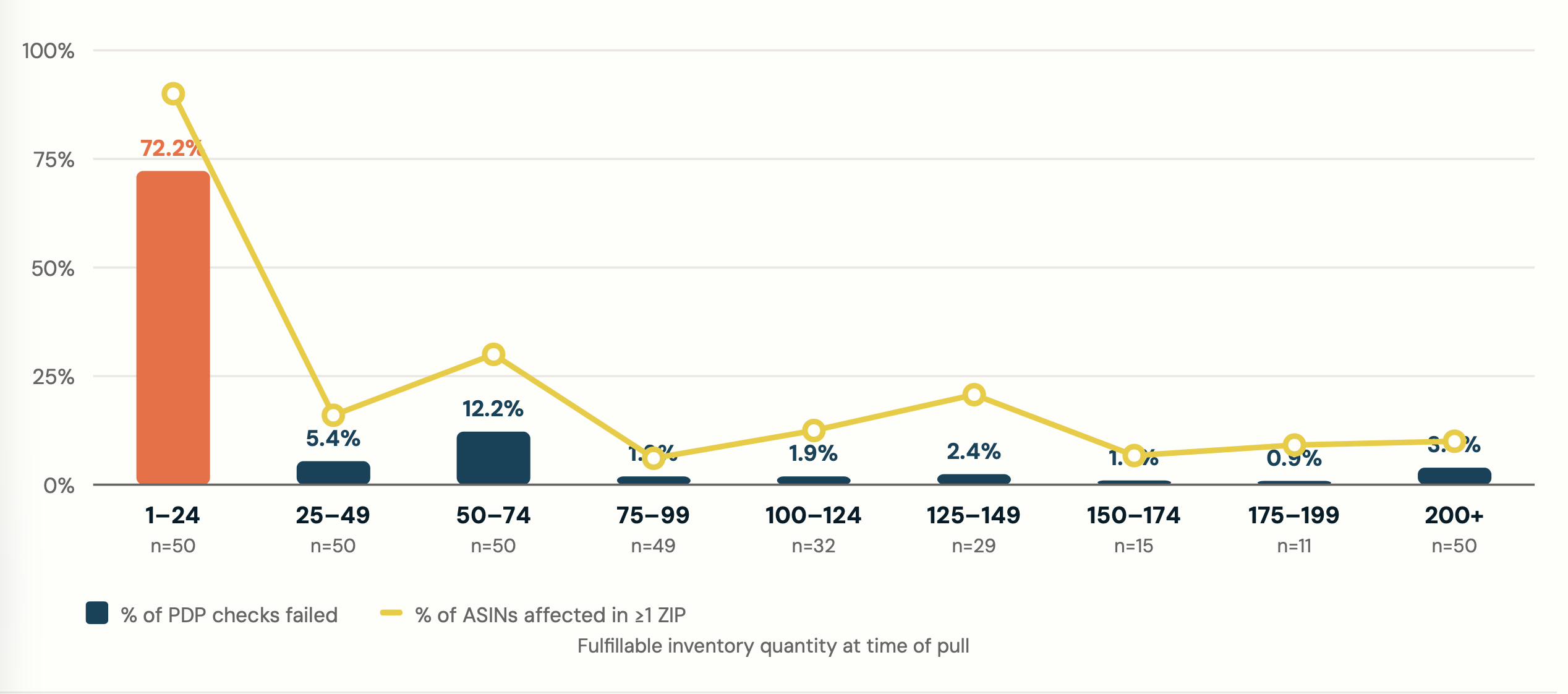
Across all 6,720 PDP checks, the overall failure rate was 14.7%. However, this average completely masks the most striking revelation of the study: the 25-unit cliff.
We expected to see a gradual curve where buy box quality slowly decayed as inventory dwindled. Instead, rates collapsed the moment inventory cleared roughly 25 units, then stayed highly consistent regardless of how much deeper the stock position got.
Key data points:
- Products with fewer than 25 units in fulfillable inventory experienced a massive 72.2% failure rate.
- ASINs sitting below the 25-unit threshold faced a 16x higher failure rate compared to properly stocked ASINs. Once inventory reached 25+ units, the failure rate plummeted to an average of 4.6%.
- One of the most surprising data points was that the 25–49 (inventory in-stock) bucket performed better than the 50–74 bucket (5.4% buy box failure versus 12.2%). However, a closer look revealed that 100 of the 122 failed checks in the 50-74 bucket came from just six ASINs, proving this to be ASIN-level noise rather than a reversal of the overall trend. Once inventory cleared 100 units, performance became remarkably consistent across the board.
What the Buy Box Failures Looked Like
When a product “failed” our checks, what exactly were customers seeing?
Out of 987 total failed checks, issues displayed as:
- “Only X left in stock – order soon.” This was the most common issue, appearing 937 times, or 94.9% of the time a failure occurred. In these instances, the brand still successfully won the buy box and the product could be purchased, however Amazon presented low-stock urgency messaging into the shopper’s experience.
- “Currently unavailable.” 50 checks, or 5.1% of failures. This response was particularly interesting because every single product tested had at least one fulfillable unit in stock at the time of the pull – Amazon just decided not to label them as such. Why would Amazon tell a buyer the product is unavailable when units exist? It comes down to ZIP codes and fulfillment network logistics. This highlights the core problem with low stock: Amazon cannot distribute a handful of units across hundreds of fulfillment centers. If a product only has two units sitting in a New Jersey facility, Amazon may show it as “Currently unavailable” to a shopper in California because the cost or time to ship it cross-country violates their Prime delivery standards or internal profitability requirements.
- No featured offer at all on 27 checks. In these cases, Amazon is still willing to ship the product but has suppressed the main “Add to Cart” button (the buy box), forcing customers to take the extra step of clicking “See All Buying Options” to manually select the specific seller.
These failures also fluctuated significantly by region. Because the same ASINs were tested everywhere, the spread reflects regional fulfillment and offer behavior. Failure rates ranged from just 3.0% in Chicago, IL (ZIP 60629) up to 18.8% in Corona, NY (ZIP 11368).
Why Do Products with Low Stock Struggle to Secure the Buy Box?
The reason for the sub-25 unit struggle comes down to Amazon’s fulfillment network scale. Amazon operates hundreds of fulfillment centers across the country. If a brand only has two or three units of an item available, Amazon simply cannot distribute those units across hundreds of fulfillment centers. Shoppers outside the immediate radius of the few stocked fulfillment centers will see degraded shipping promises, low-stock messaging, or not see the featured offer displayed on the PDP at all.
What About the Relationship Between Organic Rank and the Buy Box?
When discussing buy box ownership, it’s important to mention the downstream impact on organic search visibility. While there is a known correlation between the two, we specifically chose not to measure organic ranking throughout this study because there were simply too many variables to isolate.
Example: A customer searching for a highly specific, long-tail keyword (like a specific karat and style of jewelry) will yield completely different organic results than someone searching for a broad, highly trafficked term like “gold bracelet.”
A product’s existing sales velocity and historical traffic also heavily influence its organic rank, creating too much noise to accurately measure the sole impact of a low-inventory status on search position, especially since our study spanned several product categories.
The core truth remains: if your buy box is sub-optimal, your conversion rate will tank, and a plummeting conversion rate will inevitably drag down your organic placement.
The One Exception: High-Ticket, Low-Velocity Products
While the 25-unit rule is a crucial baseline for the majority of consumer goods brands to keep in mind, there are some brand exceptions: High-ticket, low-velocity items fulfilled through FBA, like commercial-grade cameras, specialized medical devices, or high-end professional audio equipment. Because these items fit Amazon’s physical size and weight requirements, sellers may naturally utilize FBA to secure Prime badging and Amazon’s 2-day delivery guarantee. However, enforcing a strict 25-unit minimum for a $5,000 or $10,000 SKU can be financially impractical. Carrying 25 units of a low-velocity product in Amazon’s network ties up tens or hundreds of thousands of dollars in working capital for inventory that may only sell one or two units per month.
For these specialized SKUs, maintaining a smaller, leaner FBA stock position is a calculated financial choice where the capital cost of holding excess stock far outweighs the risk of localized buy box messaging or loss.
Peak Season Will Make It Even Harder for You to Win the Buy Box
During major retail events like Prime Day or the Q4 holiday rush, maintaining this threshold becomes even more critical. As high-traffic events progress, network-wide lead times inevitably stretch. Amazon becomes highly conservative with its delivery promises to avoid missing customer expectations when fulfillment centers are slammed.
If your inventory is already hovering near the 25-unit cliff during peak periods, the strain on the fulfillment network will almost certainly compound your buy box degradation. Deeper inventory buffers are mandatory during these events to absorb the volume and maintain the featured offer.
How To Avoid Missing the Baseline When Planning Inventory
When you restock is far more critical than how much you send at once. For example, sending a massive shipment of 5,000 units (a large total buffer) won’t protect your buy box % if your supply chain allows that number to dwindle down to 5 units before the next shipment arrives. Because we see that buy box integrity drops off a cliff once inventory falls below 25 units, the secret to success is setting a strict rule (a minimum threshold) to guarantee active inventory never dips below that baseline.
Master Demand Planning with Brandwoven’s Logistics Team
The data we’ve shared today proves that maintaining a baseline of at least 25 units is not just a “best practice” but a quantifiable prerequisite for maintaining the integrity of your featured offer on Amazon.
At Brandwoven, our core service capabilities include advanced inventory forecasting, demand planning, and logistics management. We utilize proprietary data and hands-on expertise to ensure our clients avoid the “25-unit cliff” going forward.
Contact the Brandwoven team today to schedule a consultation and discover how our data-driven demand planning services can protect your featured offer and scale your brand on marketplace.