Set a goal. Add your products. Pick a budget. Amazon’s AI handles the rest.
That’s the pitch behind Amazon Ads Agent, the AI-powered advertising platform Amazon announced at unBoxed 2026. For a brand-side e-comm manager stretched thin on resources, this sounds like a dream. Less time in bulk sheets, more time on strategy. There’s a good chance someone on your leadership team has already forwarded you the announcement with a note that says “Should we be doing this?”
The catch is that when Amazon plans, runs, and optimizes your campaigns, you also give up some visibility into where your money goes. Amazon is, in a sense, grading its own homework. That doesn’t make the results wrong, but it does mean you need a way to grade it yourself.
The good news is that Amazon’s advertising automation isn’t all-or-nothing. You get to choose what to hand over, and we’ve outlined a framework for deciding which guardrails to set before you launch, and how to measure results with your own numbers.
What Changed at unBoxed 2026
On September 29, Amazon renamed the unified platform it announced last year (the ads console and Amazon DSP combined) to Amazon Ads Agent, now powered by agentic AI. It holds three campaign types:
- Sponsored Ads
- Full-Funnel Campaigns
- Display, Video, and Audio (DVA)
For each one, you can either build manually, let Amazon’s AI optimize, or use a mix of both.
Full-Funnel Campaigns
Full-Funnel Campaigns put Sponsored Products, display, video, and Streaming TV (STV) into one campaign. You supply the budget, products, and creative. Amazon’s AI plans, launches, and optimizes from there, sharing signals across formats so upper-funnel spend can lift lower-funnel ads. Reporting includes New-to-Brand and Long-Term Sales metrics. It’s in open beta for all Amazon US advertisers.
DVA+
DVA+ rolls Sponsored Display, Sponsored TV, and programmatic buying into one campaign type, powered by Brand+ and Performance+. For experienced buyers, “advanced settings” let you keep control of targeting, supply sources, deals, frequency caps, and bidding. DVA+ began rolling out in late October, and access is still expanding, so check your console to see if it’s available to you.
The Conversational Experience
Ads Agent also comes with a chat interface. Ask performance questions in plain language, get targeting recommendations, make bulk edits in DVA+, or benchmark your ROAS against category peers. Every change it proposes shows up as a summary you approve before anything goes live. It’s in closed beta, with access expanding over the coming months.
Long-Term Sales
A metric to watch is Long-Term Sales. It combines attributed sales with a modeled estimate of the future value of the new customers your ads bring in. The idea is to reward campaigns that grow your customer base, not just ones that harvest demand you already had.
What You Trade for Amazon’s Automated Advertising
Amazon’s AI can sometimes find reach a manual setup would miss, but every hand-off has tradeoffs worth knowing going in.
Some Control. In a Full-Funnel Campaign, Amazon largely decides how budget moves between formats and audiences. DVA+ advanced settings give a good chunk of that control back, but the more you lean on the simplified setup, the less you steer.
Some Reporting Clarity. When one campaign spends across Sponsored Products, display, video, and STV, it gets harder to say which format did the heavy lifting. Format-level reporting helps, but it won’t match the clarity of a campaign built around one ad type and one targeting strategy. We’ve seen blended data lead to bad decisions even inside a single Sponsored Products campaign (more on that in our breakdown of Sponsored Product ad placements).
A Second Opinion. Amazon serves the ads, attributes the sales, and models the Long-Term Sales value. That isn’t a reason to distrust the numbers, but it is a reason to check them against data like your own repeat-purchase rates and total sales trend.
Your Business Context. Amazon sees your price, current stock, and reviews. It doesn’t see your contribution margin, when your next shipment lands, next quarter’s price increase, or which product your leadership team needs to win this year.
What to Hand to AI and What to Keep Manual
The real question isn’t “AI or no AI,” it’s which jobs fit which approach.
Good Fits for AI
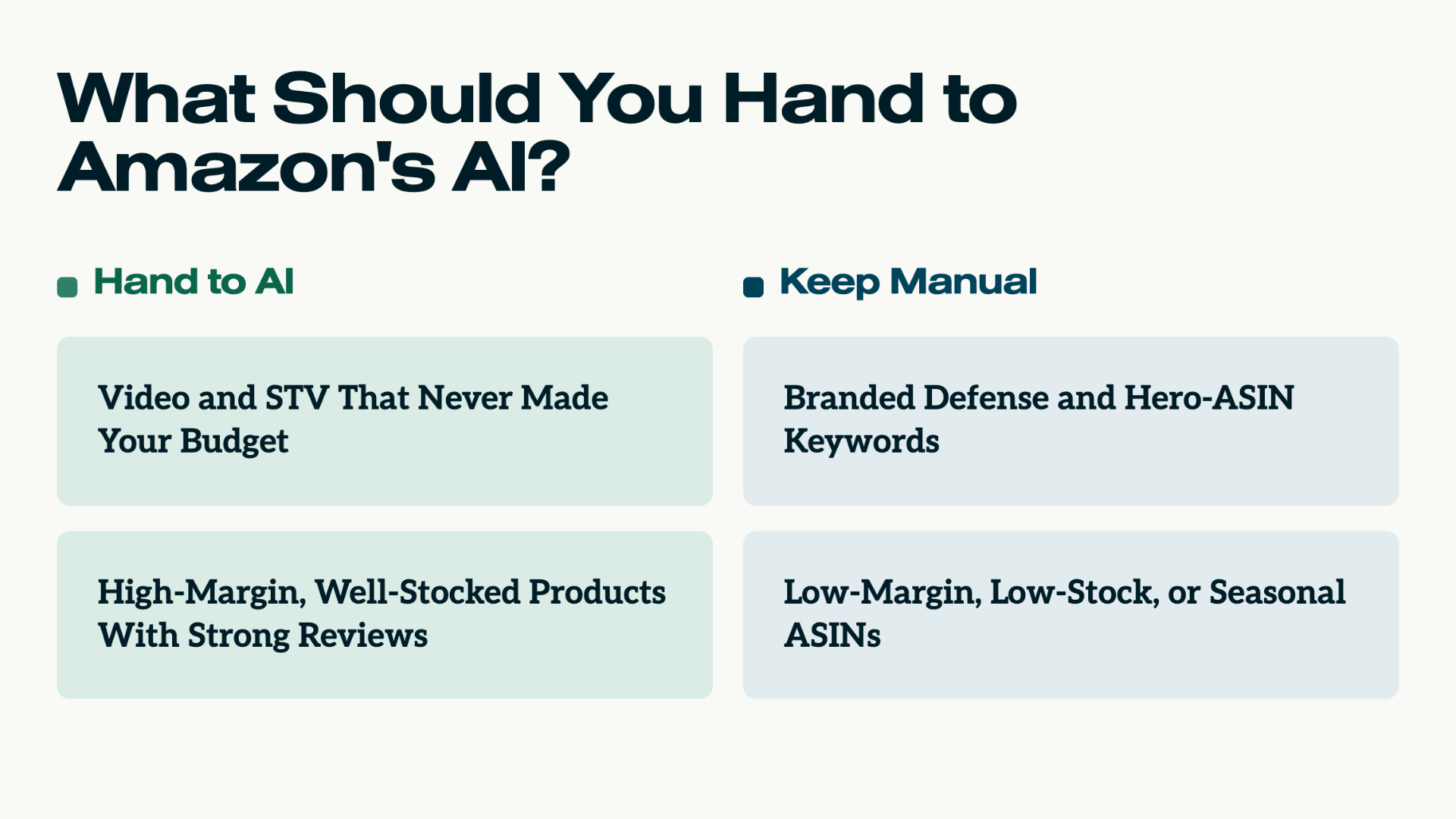
- Upper-funnel reach you’d otherwise skip. If video and STV never made the budget because they were too much work to build and manage, Full-Funnel Campaigns or DVA+ are a low-lift way in.
- High-margin, well-stocked products with strong reviews. These can absorb a learning period and convert the extra traffic AI sends them.
Keep Manual
- Branded defense and hero-ASIN keywords. These are usually your most efficient spend and the first place a competitor attacks. You want direct bid control here.
- Low-margin, low-stock, or highly seasonal ASINs. AI doesn’t know you’re three weeks from a stockout or that a product barely breaks even at full price.
- Competitor conquesting. These targets need tight bids and a clear point where you stop.
The Middle Ground: New Product Launches
Launches used to land firmly in the manual bucket — but that’s beginning to change. A new product with no sales history is exactly where AI can help find audiences and search terms you hadn’t thought of.
The trick is to split the job. Let AI handle discovery and reach, while you keep branded terms and budget pacing in manual campaigns. Where reporting shows the search terms AI found, move the winners into your own campaign structure.
A Quick Gut Check
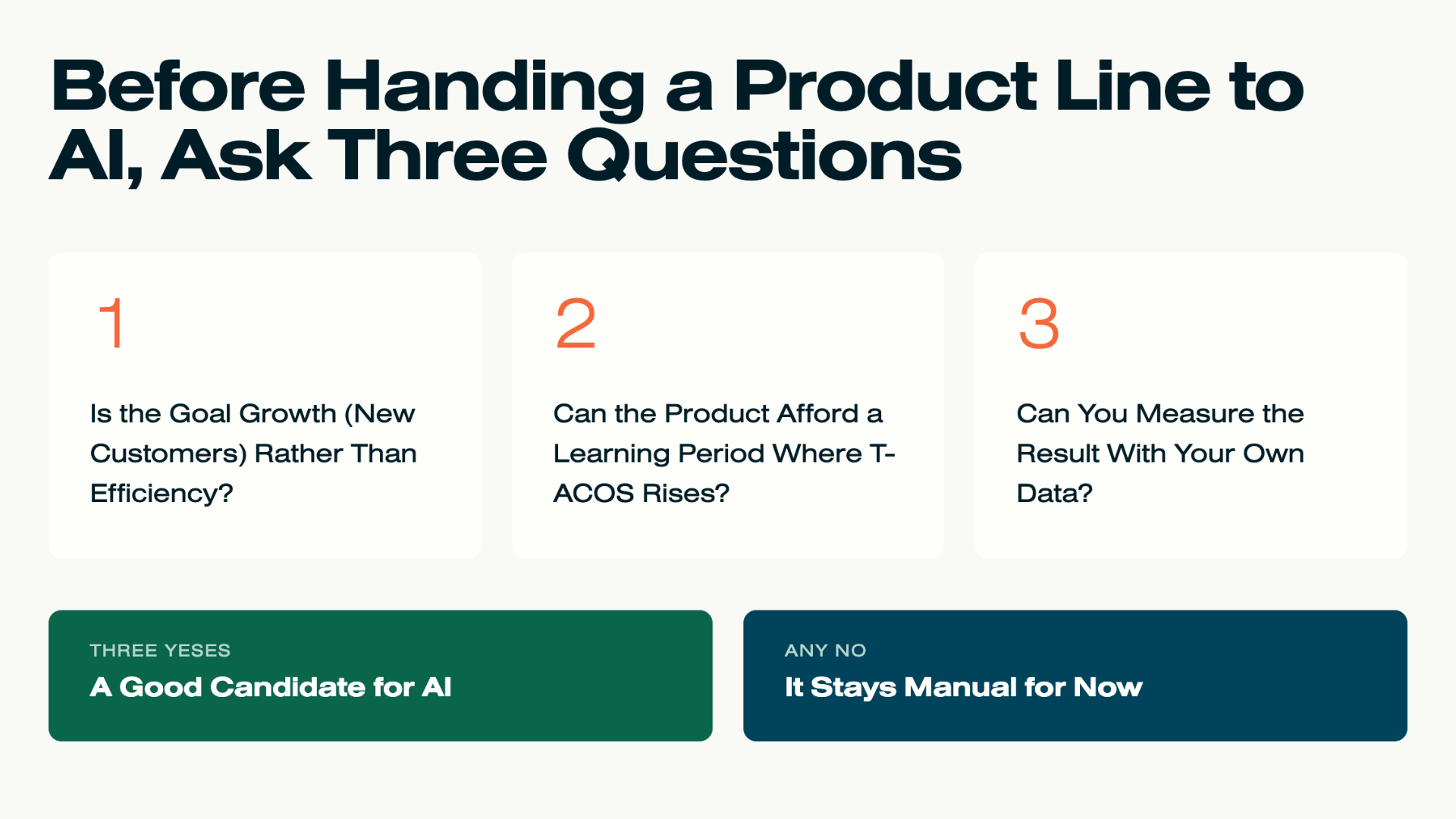
Before handing a product line to AI, ask three questions:
- Is the goal growth (new customers, new reach) rather than efficiency?
- Can the product afford a learning period where T-ACOS rises?
- Can you measure the result with your own data?
Three yeses make it a good candidate. Any no, and it stays manual for now.
Guardrails to Set Before You Launch
AI works inside the limits you give it. Set these before a single Amazon AI advertising campaign goes live.
1. Define Success in Business Terms
“More sales” isn’t a goal. Total revenue growth, New-to-Brand customer growth, or market share are. Your goal also decides which metrics matter, which we break down in 10 Key Amazon Marketing Metrics to Track Campaign Performance.
2. Know Your Margin Limits
Calculate contribution margin and break-even ACOS for each product line, then set a T-ACOS ceiling the campaign can’t cross. Break-even ACOS tells you when an ad sale starts losing money. T-ACOS tells you whether ad spend is actually lifting total sales. You need both, because AI will happily chase attributed sales right past the point where they stop being profitable.
3. Protect Your Inventory
Exclude ASINs below a set weeks-of-cover threshold. AI will push traffic to a product that’s about to stock out.
Related: Our field study on low inventory and the Featured Offer tracks how stock levels line up with Buy Box ownership.
4. Cap the Budget
As an example, try starting with AI somewhere between 10 and 20% of your total ad spend, then scale up based on results. Put AI campaigns in a portfolio with a hard budget cap. Daily budgets alone won’t hold the line, since Amazon can spend well past them on high-traffic days (we cover why in 3 Incorrect Assumptions About Amazon Ad Campaigns & Keywords).
5. Keep Your Brand in Your Hands
Review and approve every AI-generated creative before launch. Full-Funnel Campaigns require creative approval before launch, so build in review time. Keep branded keywords in manual campaigns.
6. Set a Review Cadence
Check weekly, decide monthly. Weekly reviews catch problems like runaway spend or low stock. Monthly is when you decide to scale, hold, or pull.
Measuring It (and When to Test)
Report Long-Term Sales on its own line. Don’t blend it into ROAS. It incorporates modeled future customer value beyond the immediate attributed sale. Compare it with your own repeat-purchase and Subscribe & Save data to see whether the predicted value actually shows up.
Watch total impact, not just ad metrics. The real test is whether total sales grow. Track T-ACOS and organic sales (Total Sales minus Ad Sales) next to campaign results. In Amazon Marketing Cloud (AMC), use New-to-Brand reporting to confirm you’re adding new customers, and overlap analysis to see whether AI campaigns reach new shoppers or the same ones your manual campaigns already reach. If you haven’t tapped AMC’s paid features yet, they’re free through December 31, 2026.
Test, don’t switch. Before-and-after comparisons get muddy fast. Pricing changes, promos, seasonality, and competitor moves all shift results. Instead, run a side-by-side test. Move one product line to AI and keep a comparable line manual over the same weeks. Both face the same market, so the gap between them is your answer.
Timing: Wait Until After the Holidays
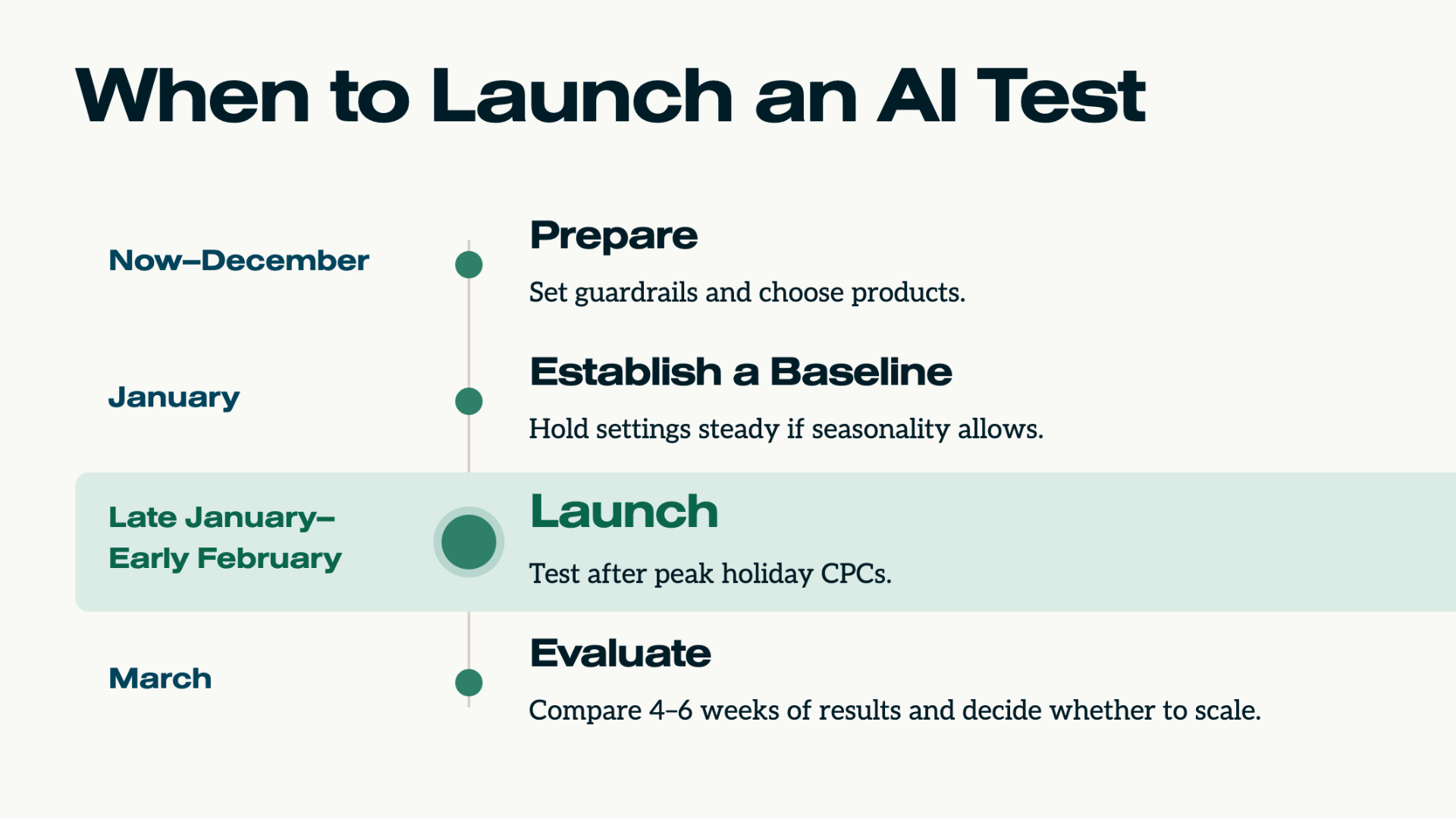
If you’re reading this in late November, hold off on launching an AI test. Black Friday and Cyber Monday bring the highest CPCs and most volatile traffic of the year. Across the brands we managed during Turkey 12 in 2025, CPCs ran 25 to 50% above their 2025 average (see our tentpole event advertising strategies guide). A campaign still in its learning period will spend at peak prices, and the results won’t tell you anything about a normal month. Here’s how we’d sequence it:
- Now Through End of December: Run your holiday plan as built. Use the downtime between check-ins to set guardrails, define success, and pick your test and control product lines. December brings a sales rush, then a drop in traffic heading into the final two weeks of the year.
- January: If January isn’t a highly seasonal month for your brand, keep campaign settings steady to set a baseline that you can compare back to.
- Late January-Early February: Launch the test.
- March: After running for 4-6 weeks, assess the new data against your baseline. Make the call to scale, hold, or pull.
Final Thoughts
Amazon’s AI-powered advertising automation is good at finding reach and new customers. It doesn’t know your margins, your launch priorities, or what your leadership team is measuring you on. That’s still your job.
Automate selectively. Hand AI the jobs it’s built for, keep manual control where precision matters, set your guardrails before launch, and measure everything against your own numbers.
Connect with Brandwoven’s marketing team to build an AI test plan and guardrails for your brand on Amazon.